The Physics of a Double Lens: Why Your Ski Goggle Has Two Layers
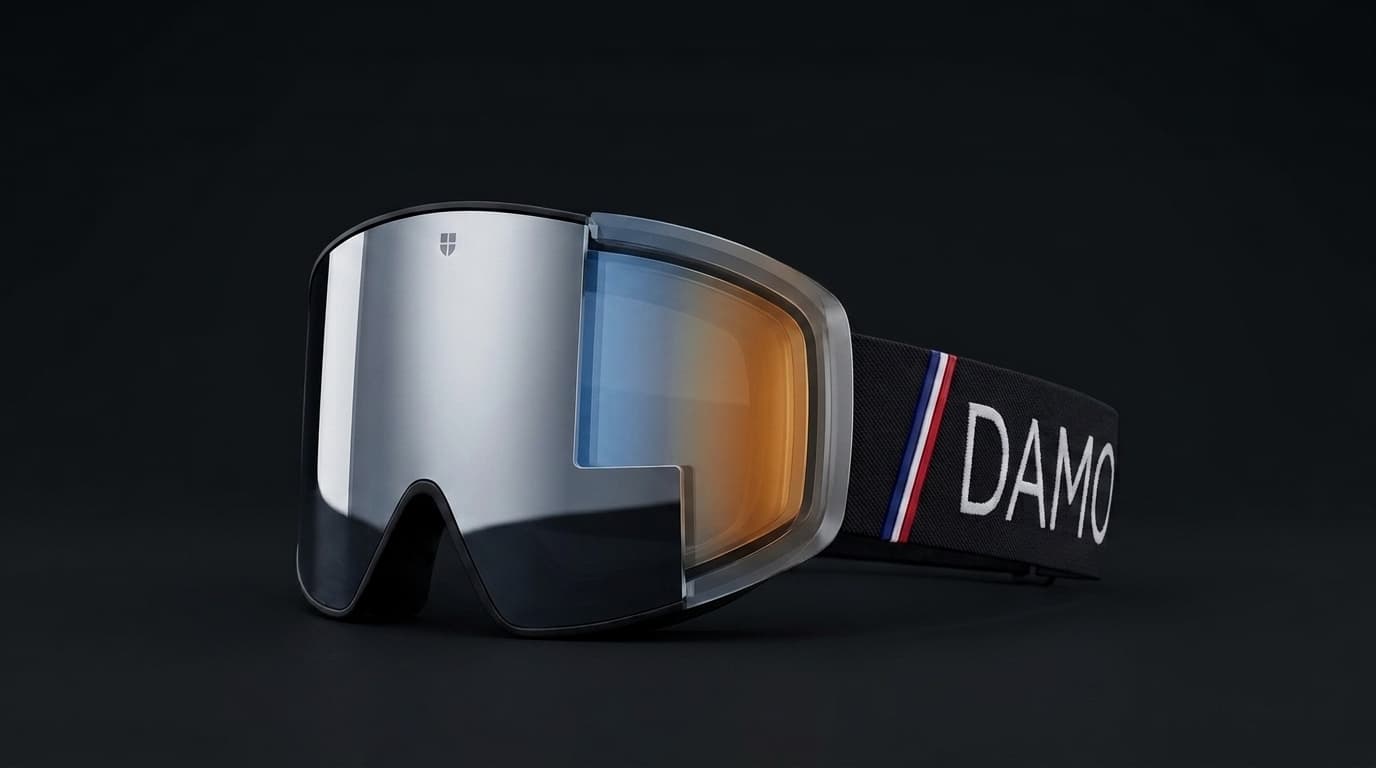
The sealed air gap between inner and outer lenses is thermal insulation — just like double-pane windows. Discover the temperature gradient, Fourier's law, and Damo's PC + CA construction.
“**The short version:** A dual-lens goggle isn't a gimmick — it's a thermal insulator. The air trapped between the two layers slows heat transfer between your face (~25 °C) and the outside air (-10 to -30 °C), preventing condensation on the inner lens. The principle is identical to double-pane windows. Here is how it works, and why the gap distance between the lenses is a critical design parameter.”
— The short version:
The Problem: Why Goggles Fog
Fog is condensation. Warm, moist air from your breath meets a cold surface, its temperature drops below the dew point, and water transitions from gas to liquid — in micro-droplets that scatter light.
The intuitive solution is simple: keep the inner lens warm enough. But how, when it is -20 °C outside and your face is radiating 25 °C?
Thermal Insulation: The Double-Pane Window Analogy
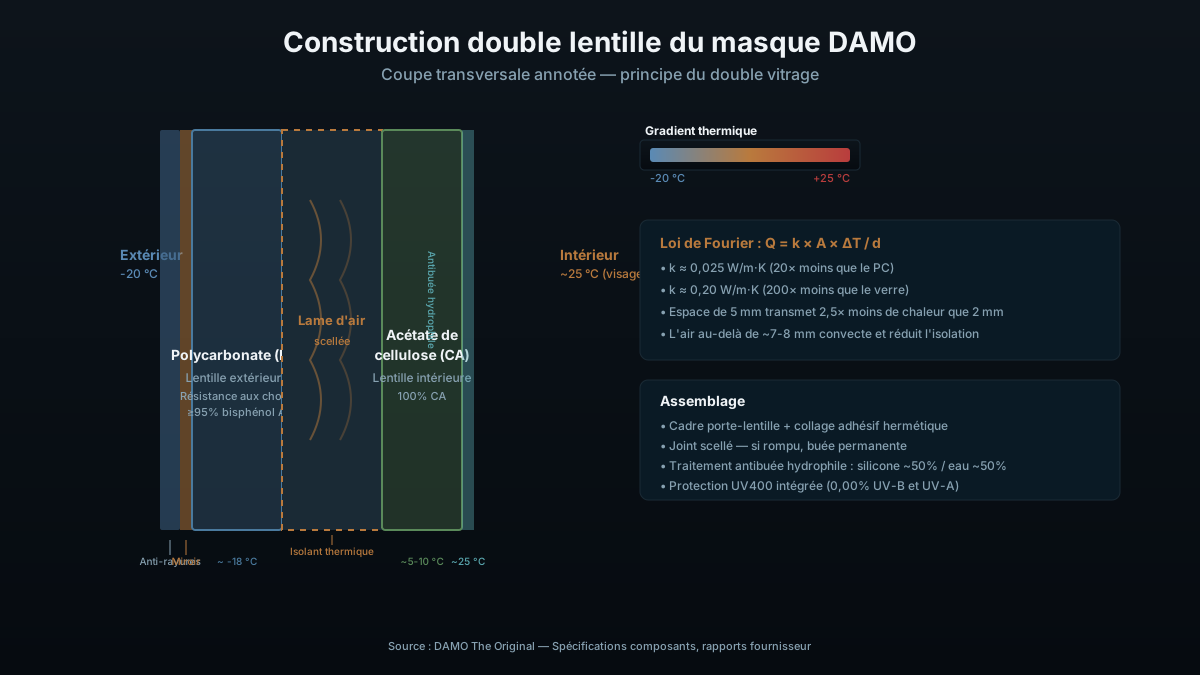
A double-pane window works by trapping a layer of air (or gas) between two panes of glass. Air is a poor thermal conductor — its thermal conductivity is very low. The result: heat from the interior takes much longer to reach the exterior, and the inner pane stays close to room temperature.
A dual-lens ski goggle applies exactly the same principle:
| Component | Role |
|---|---|
| **Outer lens** (polycarbonate) | Impact resistance, hosts mirror coating, exposed to cold |
| **Sealed air gap** | Thermal insulator — stagnant air conducts heat very poorly |
| **Inner lens** (cellulose acetate) | Hosts anti-fog coating, stays close to face temperature |
The Temperature Gradient: -20 °C to +25 °C in a Few Millimetres
The temperature difference across the goggle can reach 40–50 °C. Without the air gap, the inner lens would be nearly as cold as the outside — and fogging would be immediate.
With the air gap, temperature drops progressively across the layers:
Outside -20 °C
    │
    ▼
PC outer lens → very cold (~ -18 °C)
    │
    ▼
◈ Sealed air gap ◈ → gradual gradient (the air insulates)
    │
    ▼
CA inner lens → significantly warmer (~ 5–10 °C above dew point)
    │
    ▼
Face ~ 25 °C
As long as the inner lens stays above the dew point of the trapped air, fog does not form. That is the air gap's job.
The Physics in One Equation: Q = k × A × ΔT / d
Steady-state heat transfer through a flat plane is described by Fourier's law:
**Q = k × A × ΔT / d**
Where:
- **Q** = heat flux (W)
- **k** = thermal conductivity of the material (W/m·K)
- **A** = lens area (m²)
- **ΔT** = temperature difference across the layer (K)
- **d** = layer thickness / gap distance (m)
What matters for goggle design:
- **k of air** ≈ 0.025 W/m·K — that is 20 times lower than polycarbonate (k ≈ 0.20 W/m·K) and **200 times lower** than glass. Air is an excellent insulator.
- **d (gap distance)**: the larger the gap, the lower the heat flux. But a larger gap increases goggle depth and can reduce the field of view. It is an engineering trade-off.
- The production-spec sealed air gap is designed to provide optimal thermal insulation — this measurement is locked as a key design parameter.
Why Gap Distance Matters
Consider two hypothetical goggles:
- **2 mm gap**: Q = k × A × 45 K / 0.002 = 22,500 × k × A
- **5 mm gap**: Q = k × A × 45 K / 0.005 = 9,000 × k × A
The 5 mm gap goggle transfers **2.5 times less** heat. Its inner lens stays warmer, therefore stays above the dew point longer.
However, beyond a certain threshold (roughly 7–8 mm for a goggle-scale lens), the trapped air starts to circulate via natural convection inside the sealed cavity, which increases heat transfer and reduces insulation efficiency. This is why the design must be optimised, not simply stretched.
The Original's Lens Construction
The Original stacks its layers as follows, from outside to inside:
- **Anti-scratch hard coat** (outermost surface) — a protective layer that shields the polycarbonate from abrasion
- **Mirror coating** (outer face of the PC lens) — SiO₂/Ti₃O₅ dielectric stack that produces colour and reduces incident light before it reaches the tint
- **Outer lens** — optical-grade polycarbonate, ≥95 % bisphenol A + diphenyl carbonate
- **Sealed air gap** — thermal insulator, optimised for the production design
- **Inner lens** — cellulose acetate (CA), 100 %, with permanent silicone-based anti-fog coating on its inner face
- **Hydrophilic anti-fog treatment** — silicone ~50 % / purified water ~50 % film that absorbs residual moisture and spreads it into a transparent sheet
The entire assembly is held by a lens carrier frame and adhesive bonding.
When the Seal Fails: Permanent Fog
The weak point of any dual-lens system is the **seal**. If the seal is compromised — by impact, extreme heat (a car dashboard on a sunny day), or material fatigue — humid air enters the sealed cavity.
Two problems follow:
- **The trapped humid air cannot escape** — it is sealed in. Each breath/rest cycle adds more moisture.
- **The inner lens cools down** — without effective insulation, its temperature drops below the dew point, and condensation becomes permanent.
A goggle with a damaged seal fogs continuously, regardless of conditions. There is no repair: the entire lens assembly must be replaced.
FAQ
What is the difference between a sealed dual lens and a single lens with anti-fog spray?
A sealed dual lens thermally insulates the inner lens — it is a **physical** solution to condensation. Anti-fog spray is a **chemical** solution that does not compensate for cold: it absorbs moisture, but if the lens is too cold, the water volume exceeds the film's capacity and fog appears. The combination of both approaches (insulation + hydrophilic coating) is why dual-lens goggles are far more effective.
Is polycarbonate really better than glass for the outer lens?
Yes, for three reasons: PC is far more impact-resistant than glass or acrylic (essential for branch strikes and hard snow hits), it is lighter, and it does not shatter into sharp fragments. Its downside is that it is softer — hence the need for an anti-scratch hard coat.
Why does Damo use cellulose acetate for the inner lens?
CA offers excellent compatibility with hydrophilic anti-fog treatments: silicone adheres better to CA than to PC. CA is also more flexible than PC, reducing mechanical stress during dual-lens assembly. Finally, CA has a slightly lower thermal conductivity than PC, which marginally improves insulation.
Can I tell if my goggle's seal has failed?
Not easily without risking damage. Visual signs: a persistent white haze between the two lens layers that does not clear with normal cleaning, or visible distortion around the frame border. If you suspect a problem, replace the lens assembly — do not try to repair it.
Why does my dual-lens goggle still fog briefly after hard exertion?
Intense exertion produces a large volume of water vapour (rapid breathing and sweat). The dual lens delays condensation, but if moisture production temporarily exceeds the hydrophilic coating's absorption capacity, a brief haze can form. It usually clears within seconds as breathing slows and dry air in the goggle recirculates.
Sources
- [DAMO SUPPLIER DATA] — The Original: component specifications, dual-lens assembly report.
- 14-product-spec-lenses.md — Damo product specification document, §2 Construction.
- Stefan Kaelin — "How Anti-Fog Works in Double-Lens Visor Helmets." [stefankaelin.com](https://stefankaelin.com/blogs/blog/how-anti-fog-technology-works-in-double-lens-visor-ski-helmets)
- Alpenglow Adventure Sports — "Ski Goggle Technology Explained: Lens Types, Anti-Fog Systems, and Fit Guide." [alpenglowgear.com](https://alpenglowgear.com)
- Out Of — "Anti-fog tech pills" [out-of.com](https://out-of.com/tech-pills-anti-fog)
- EN ISO 18527-1:2022 — Requirements for downhill skiing and snowboarding goggles.
- General thermal physics — Fourier's law, conduction, convection.
*Published August 28, 2026 — Category: Lens Science (SCI)*
The DAMO goggle — two lenses included, €80 on preorder
Sealed double anti-fog lens, magnetic interchangeable lens system, and a free yellow fog lens. Free shipping in France.
Visit the shopRelated articles
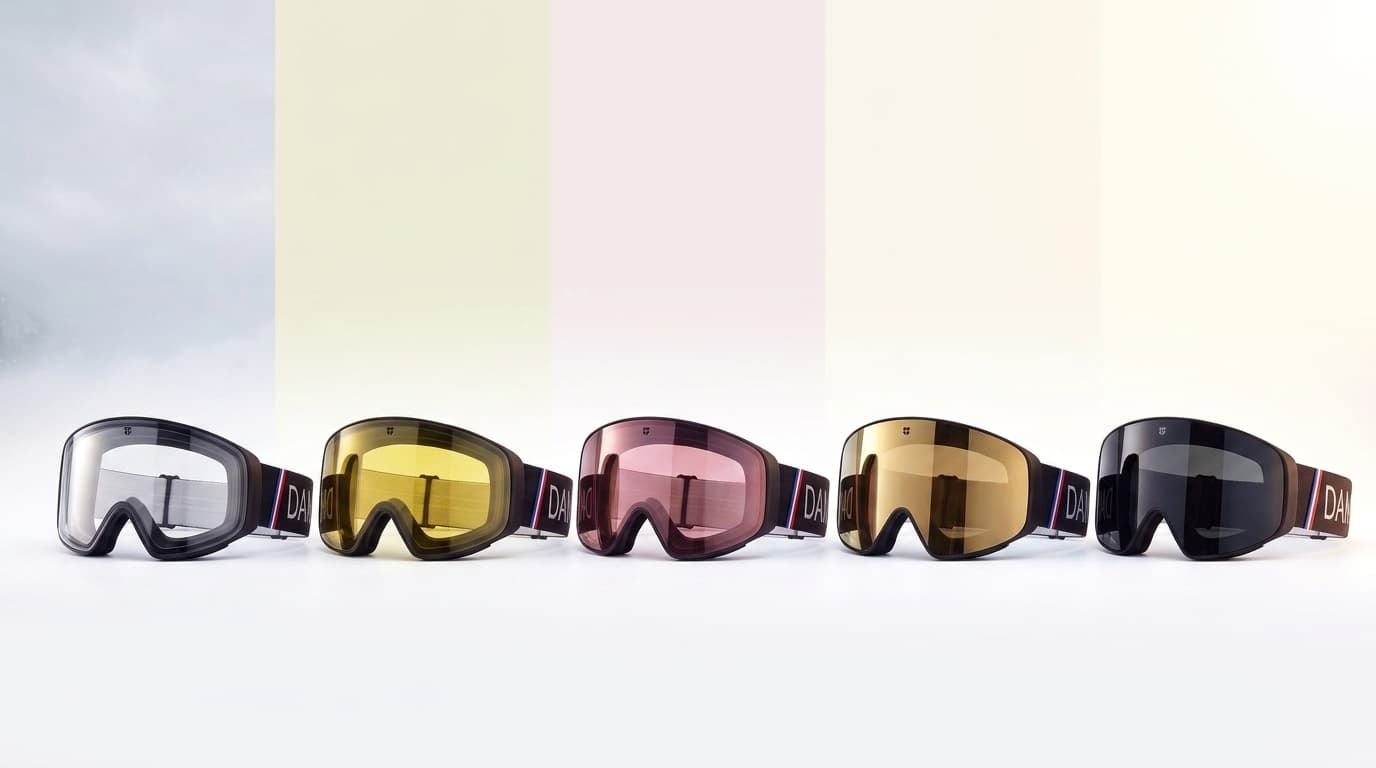
2026-08-28
What Is VLT in Ski Goggles? Complete S0–S4 Guide
Everything you need to know about VLT (Visible Light Transmission) and S0–S4 filter categories for ski goggles: EN ISO 18527-1 standard, spectrophotometry, worked examples with DAMO lens values.
2026-08-28
Lab Tests vs Real Slopes: What Certifications Don't Tell You
Lab tests prove safety. They don't prove a goggle will perform on the mountain. Here's what certifications really measure — and what they leave out.