What Is VLT in Ski Goggles? Complete S0–S4 Guide
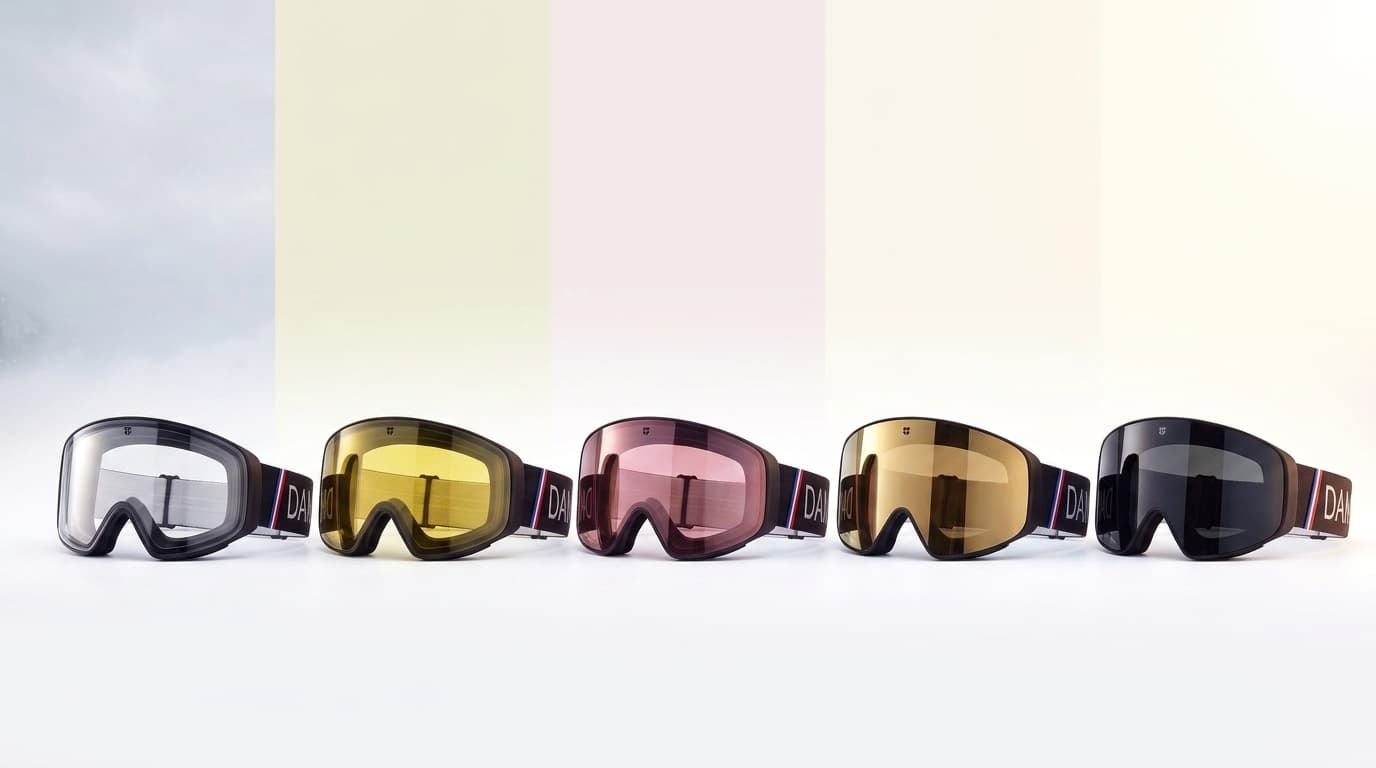
Everything you need to know about VLT (Visible Light Transmission) and S0–S4 filter categories for ski goggles: EN ISO 18527-1 standard, spectrophotometry, worked examples with DAMO lens values.
“**VLT — Visible Light Transmission — is the percentage of visible light that passes through a goggle lens and reaches your eye. It is the single most important specification for choosing the right lens for the conditions.** This guide explains how VLT works, the five S0–S4 categories defined by EN ISO 18527-1, how it's measured in a lab, and how to interpret it using DAMO's lens values as worked examples.”
— VLT — Visible Light Transmission — is the percentage of visible light that passes through a goggle lens and reaches your eye. It is the single most important specification for choosing the right lens for the conditions.
At a Glance
- **VLT = Visible Light Transmission**: the amount of visible light (380–780 nm) a lens lets through.
- **5 categories**: from S0 (80–100%, night) to S4 (3–8%, extreme sun).
- **Scientific measurement**: UV-VIS spectrophotometer with D65 illuminant (standard daylight).
- **Uniformity requirement**: the difference between left and right lenses must not exceed 15%.
- **DAMO's main lenses are S3** (8–18% VLT) with an additional S1 fog lens (~75%) for low light.
Why VLT Is the One Number That Really Matters
Browse any ski goggle product page and you'll find a parade of marketing claims: "enhanced contrast," "high-definition vision," "natural colour." But only one figure is **standardised, measurable, and comparable across every brand**: VLT.
Everything else builds on this foundation. A lens that's too dark in flat light is a safety hazard. A lens that's too bright in full sun causes eye fatigue. VLT is the universal guardrail.
The Five S0–S4 Categories (EN ISO 18527-1)
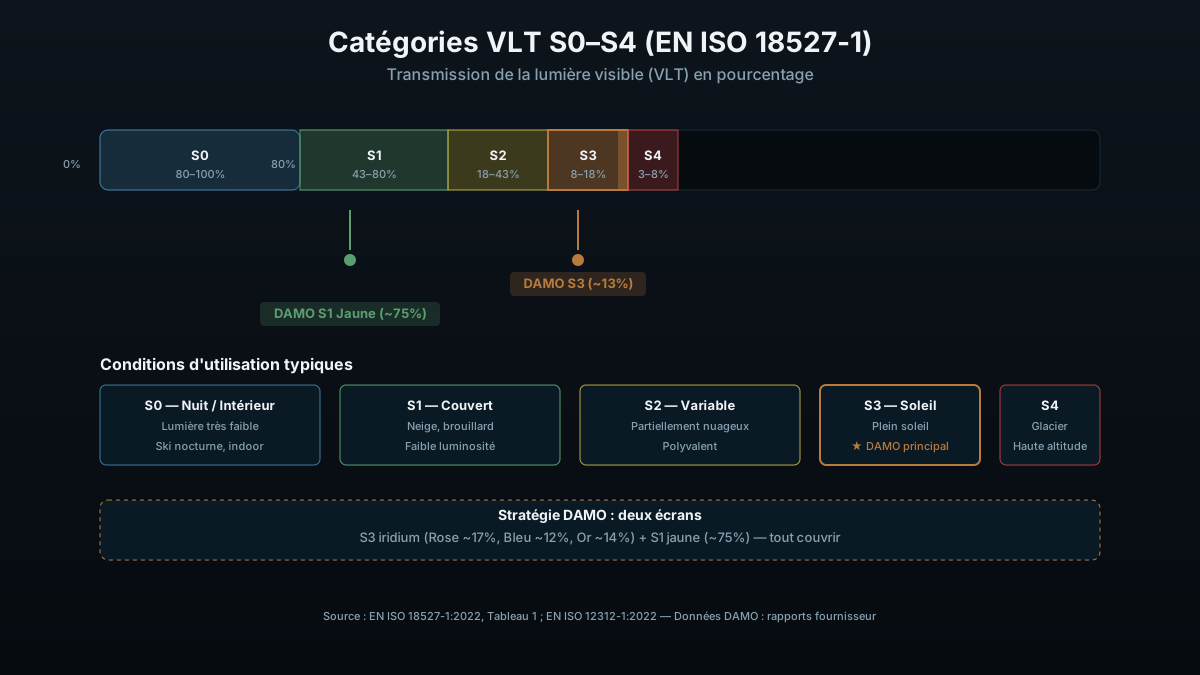
Ski goggle filter categories are defined by **EN ISO 18527-1:2022** — the harmonised European standard for Category II personal protective equipment (PPE) used in skiing and snowboarding.
| Category | VLT Range | Typical Condition | Use Case |
|---|---|---|---|
| **S0** | **80–100%** | Extremely low light | Night skiing / indoor |
| **S1** | **43–80%** | Overcast / storm | Heavy snow, fog, flat light |
| **S2** | **18–43%** | Medium / partly cloudy | Variable conditions, all-rounder |
| **S3** | **8–18%** | Full sun | Bluebird days — **DAMO's primary lens category** |
| **S4** | **3–8%** | Extreme sun / glacier | High alpine, intense glare |
*source: EN ISO 18527-1:2022, Table 1; EN ISO 12312-1:2022*
Why S3 Is the Most Common Category
For typical resort skiing (1,500–2,500 m elevation), most skiers encounter bright sun or partly cloudy skies. S3 (8–18% VLT) covers the vast majority of these conditions — which is why DAMO positioned all three launch lenses in S3.
The S1 Fog Lens
An S1 lens (43–80% VLT) lets through significantly more light. It's designed for very low-light conditions: heavy snowfall, thick fog, late afternoon. The yellow fog lens included with every DAMO pack is an S1 lens with a measured VLT of approximately 74–75%.
How VLT Is Measured
VLT isn't an estimate — it's a standardised laboratory measurement.
The Instrument: UV-VIS Spectrophotometer
A spectrophotometer equipped with an integrating sphere scans the lens with light across the full visible spectrum (380–780 nm) and measures what proportion transmits through at each wavelength.
The Three Parameters of the Measurement
- **D65 illuminant**: A standardised light source that reproduces daylight at approximately 6,500 K correlated colour temperature (sun + diffuse sky). It's the international reference for all colour measurements.
- **CIE 1931 Standard Observer**: A mathematical model of average human eye response, used to weight each wavelength by the eye's sensitivity.
- **The calculation**: τv = [∫ T(λ) · S_D65(λ) · V(λ) dλ] / [∫ S_D65(λ) · V(λ) dλ]
In plain terms: the measured transmission T(λ) at each wavelength is integrated, weighted by the daylight spectrum (D65) and the eye's photopic luminosity curve (V(λ)), across the visible band.
The Uniformity Requirement
EN ISO 18527-1 requires that the variation in luminous transmittance within a single lens does not exceed 15% (relative to the higher value), and that the difference between left and right lenses also stays within 15%. Why? An unbalanced brightness between the two eyes causes eye strain and depth-perception errors — dangerous on snow.
DAMO Values as Worked Examples
| Variant | Mean VLT (R+L) | Category | Uniformity difference | Within 15%? |
|---|---|---|---|---|
| Pink | ~17.00% | S3 | 3.41% | ✅ Pass |
| Dream Blue | ~12.06% | S3 | 0.08% | ✅ Pass |
| Gold | ~13.95% | S3 | 1.92% | ✅ Pass |
| Yellow fog lens | ~74–75% | S1 | — | — |
All three DAMO lenses comfortably meet the uniformity requirement. The Dream Blue variant, with only 0.08% difference between left and right, is particularly noteworthy.
*source: Supplier optical reports — Pink.pdf, Dream blue.pdf, gold.pdf (supplier/internal)*
**Important note:** These measurements are supplier technical data, referencing ISO/DIS 18527-1:2022. They are presented here for educational illustration of how VLT measurement works.
VLT and UV Protection: Don't Confuse Them
A critical point often misunderstood: **VLT has nothing to do with UV protection**. An S0 lens (80–90% VLT) can block 100% of UV, and an S4 lens (3–8% VLT) can have poor UV protection. UV protection depends on the lens material and coatings, not its darkness.
All DAMO lenses provide UV400 protection, with measured UV-B and UV-A transmission of 0.00% based on supplier optical measurements — far exceeding minimum standard requirements.
How to Choose Your VLT
Quick Reference
| Condition | Recommended category |
|---|---|
| Bright sun (high altitude, glacier) | S3 or S4 |
| Sun with some clouds | S3 |
| Variable / partly cloudy | S2–S3 |
| Overcast / light snow | S1–S2 |
| Storm / heavy fog | S1 |
| Night skiing | S0 |
The DAMO Strategy: Two Lenses
DAMO designed its launch pack to cover two ends of the brightness spectrum with two lenses:
- **S3 iridium lens** (Pink ~17%, Blue ~12%, Gold ~14%) → sunny to partly cloudy days
- **S1 yellow lens** (~75% VLT) → low light, snowfall, fog
This is a proven, straightforward approach. No photochromic mechanism to maintain, no optical compromise — each lens is optimised for its VLT range.
FAQ
**1. Can I use an S3 lens for night skiing?** No. An S3 lens transmits only 8–18% of visible light — dangerously dark for night use. You need an S0 lens, or at a stretch an S1 lens (like DAMO's yellow fog lens) for very low light.
**2. What's the difference between VLT and filter category?** VLT is the exact measured percentage (e.g., 17.00%). The category (S0–S4) is the regulatory range that measurement falls into. Both are connected, but VLT is the precise figure.
**3. Does a darker lens protect better against UV?** No. UV protection depends on the lens material and coatings, not how dark the lens is. A clear S0 lens can have perfect UV400 protection. Always check for UV400 labelling or EN ISO 18527-1 compliance.
**4. How can I tell if a lens is correctly categorised?** The manufacturer must provide the measured VLT value. In Europe, ski goggles must comply with EN ISO 18527-1, which requires the category to be marked on the product. If it isn't, compliance is questionable.
**5. What does "S3 with 3.41% uniformity" mean in the DAMO table?** It means the luminous transmittance difference between the right eye (16.70%) and left eye (17.29%) is 3.41% relative to the higher value. The regulatory threshold is 15%, so the lens passes comfortably. Lower uniformity difference means better balanced vision between the two eyes.
Sources
- EN ISO 18527-1:2022 — Eye and face protection for sports use. Part 1: Requirements for downhill skiing and snowboarding goggles
- EN ISO 12312-1:2022 — Sunglasses for general use. Filter categories
- ISO 18526-2:2020 — Test methods for physical optical properties
- Shimadzu, "Color Measurement" (spectrophotometry reference)
- Giro Sport Design, "What Does VLT Mean?" — https://www.giro.com (retrieved 28 August 2026)
- REI Co-op, "Snow Goggle Lens Colors Explained" — https://www.rei.com (retrieved 28 August 2026)
- The Original — Optical reports: Pink.pdf, Dream blue.pdf, gold.pdf (supplier/internal)
- Supplier optical report — PC yellow lens without coating.pdf (yellow lens) (supplier/internal)
- DAMO Gears, 14-product-spec-lenses.md (internal)
- Intertek SHAH01697484 — Test report (supplier/internal)
*Last updated: 28 August 2026. Published by DAMO Gears.*
The DAMO goggle — two lenses included, €80 on preorder
Sealed double anti-fog lens, magnetic interchangeable lens system, and a free yellow fog lens. Free shipping in France.
Visit the shopRelated articles
2026-08-28
UV Protection in Ski Goggles: The Complete Guide
Complete guide to UV protection in ski goggles: UV400, ISO 18527-1 standards, altitude effects, myths debunked, and what to look for when buying.
2026-08-28
Lab Tests vs Real Slopes: What Certifications Don't Tell You
Lab tests prove safety. They don't prove a goggle will perform on the mountain. Here's what certifications really measure — and what they leave out.