Mirror Coatings: Colour, Spectacular, Science
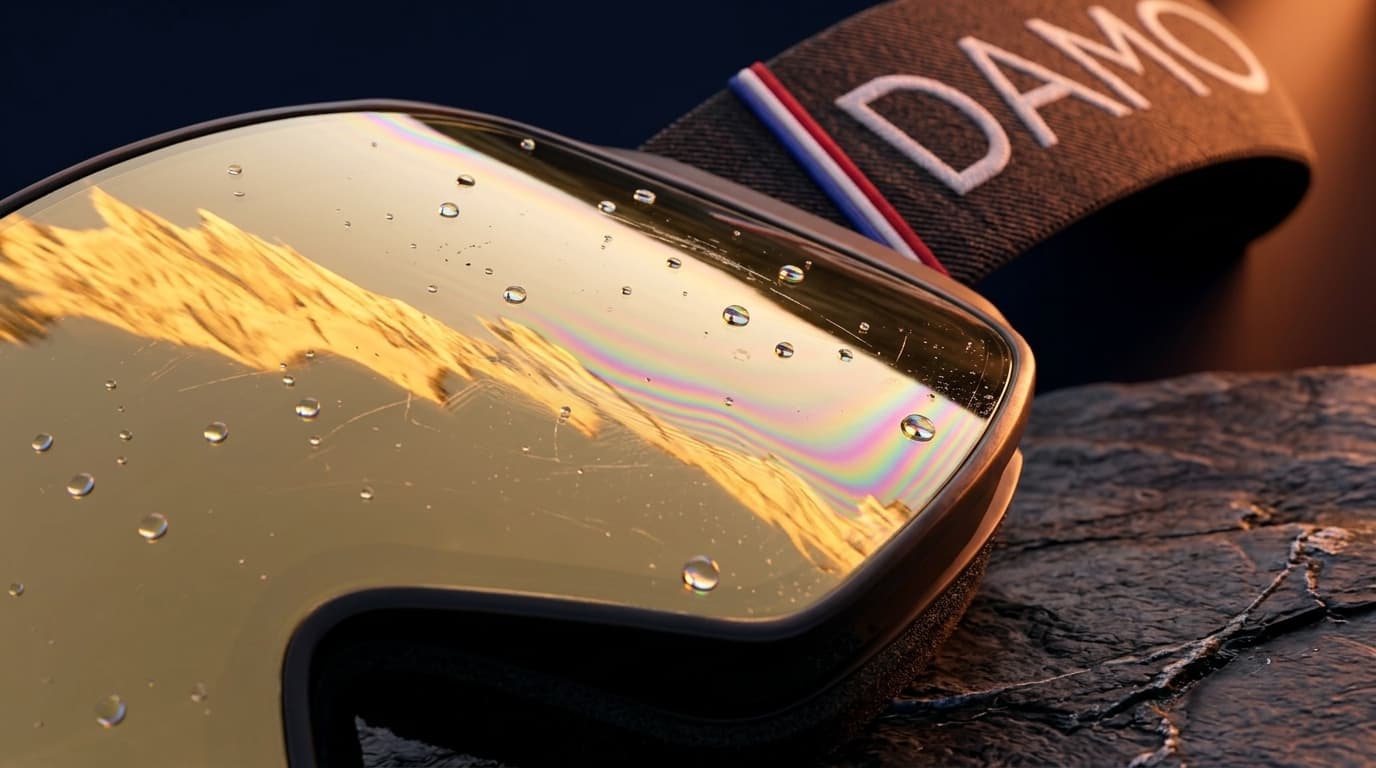
Mirror coatings aren't dyed — their colour comes from light interference in nanometre-precise stacks of SiO₂ and Ti₃O₅. How Damo's dielectric mirrors improve colour rendering at low VLT.
“**The short version:** The colour of a mirror coating does not come from dye. It is produced by thin-film interference in alternating layers of SiO₂ and Ti₃O₅, each a precise nanometre thick. These dielectric stacks reflect a portion of incoming light before it reaches the lens tint, improving colour rendition at low VLT. Here is how it works — and how to care for it.”
— The short version:
What You See Is Not a Dye
Look at a mirror-coated goggle lens under good light: it reflects an intense colour — pink, blue, gold. It is easy to assume a pigment or dye has been added to the material. That assumption is wrong.
The colour you perceive comes from **light interference** in a stack of transparent oxide layers, each thinner than a light wave. The same physics that colours soap bubbles and butterfly wings is here engineered at the nanoscale.
Thin-Film Interference: A Quick Refresher
When light hits an interface between two transparent materials with different refractive indices, part is reflected and part is transmitted. If the layer is thin enough — on the order of the wavelength of light, a few hundred nanometres — the reflections from the front and back surfaces of the layer interfere with each other.
- **Constructive interference**: certain wavelengths are reinforced and reflected → that is the colour you see.
- **Destructive interference**: other wavelengths cancel out and pass through → they reach the tint and are absorbed.
The reflected colour depends on the **optical thickness** of each layer (refractive index × physical thickness). By adjusting the thickness of the SiO₂ and Ti₃O₅ deposits, the mirror colour is "tuned" — much like tuning a guitar string by changing its tension.
The Damo Stack: Alternating SiO₂ and Ti₃O₅
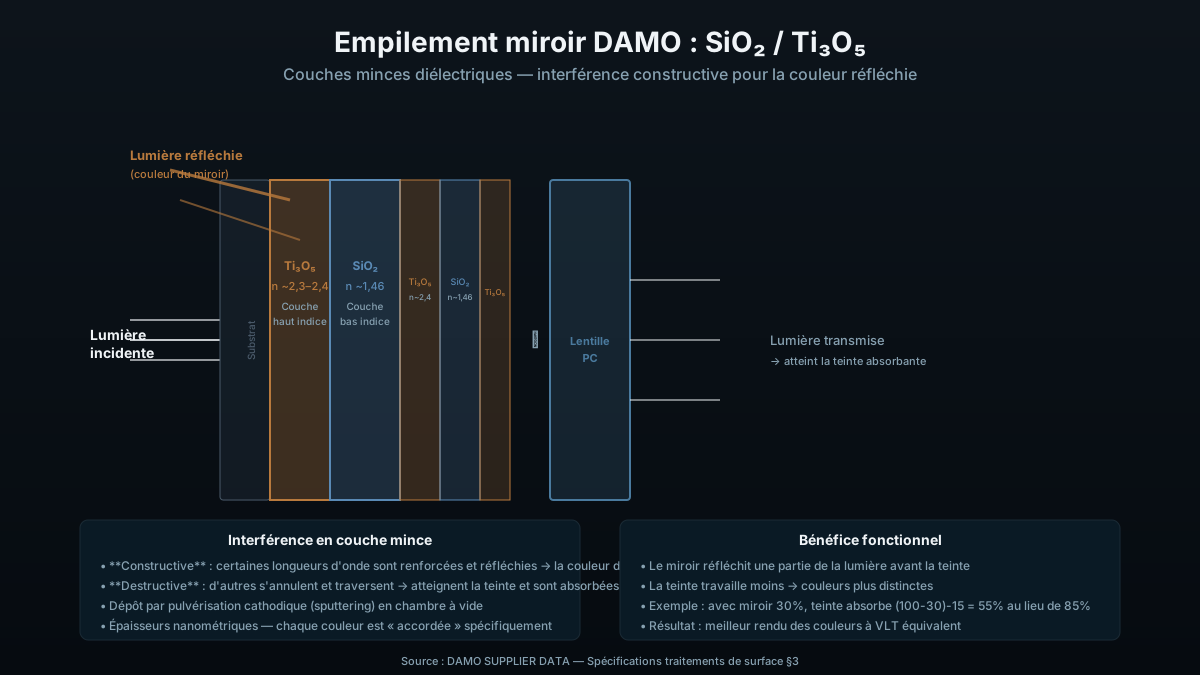
Damo's goggle uses a **dielectric stack** composed of two materials:
| Material | Refractive Index | Role |
|---|---|---|
| **SiO₂** (silicon dioxide) | ~1.46 (low) | Low-index layer |
| **Ti₃O₅** (trititanium pentoxide) | ~2.3–2.4 (high) | High-index layer |
The layers are deposited by **sputtering** in a vacuum chamber. The result is a **dielectric mirror** — a reflector that can achieve far higher reflectivity than metal at specific wavelengths while remaining perfectly transparent to others.
Why the Ratio Varies by Colour
The ratio between the SiO₂ and Ti₃O₅ layer thicknesses determines which wavelengths are constructively or destructively interfered:
- **Damo Pink**: the stack is optimised to reflect red/pink (around 650 nm reinforced, ~500 nm suppressed).
- **Dream Blue**: reflection is centred on blue (~460 nm).
- **Gold**: reflection combines red and green (around 550–600 nm), producing a golden appearance.
The exact thicknesses are proprietary — that is the manufacturer's expertise — but the material ratios are documented in the supplier specification.
The Functional Benefit: Less Light Before the Tint
The mirror is not just for looks. It has a concrete optical role:
- **The mirror reflects a portion of incident light** before it reaches the absorbing tint.
- **The tint absorbs the remainder** to hit the target VLT (S3: 8–18 %).
- **Result:** the tint can be less dense than if it had to do all the work alone, which **improves colour rendering**.
Consider a worked example. White light arrives at the lens:
- Without mirror: the tint must absorb ~85 % of light to achieve 15 % VLT. Such strong absorption compresses the differences between colours.
- With 30 % mirror: the mirror reflects 30 %, the tint only needs to absorb (100 % − 30 %) − 15 % = 55 %. It works less, colours stay more distinct.
This is why S3 mirror lenses can look visually more "vibrant" than non-mirror S3 lenses, even at equivalent solar protection.
Mirror vs Tint: Two Different Mechanisms
| Property | Tint | Mirror (reflective coating) |
|---|---|---|
| Mechanism | Selective **absorption** of wavelengths | **Reflection** via interference |
| Effect on light | Unabsorbed colours pass through | Some colours reflected, others transmitted |
| Exterior appearance | Slightly coloured (tint visible) | Highly reflective / mirror-like |
| Interior view | Filtered colour | Clear view (mirror works in the opposite direction) |
| Fragility | Very durable (in the bulk material) | Fragile (surface-layer stack) |
Care Advice: Mirror Coatings Are Fragile
A mirror coating is a stack of oxide layers on the lens surface. It is **mechanically fragile** — far more so than a standard tinted lens.
**Do:**
- Use only the provided microfiber cloth to **dab** (never rub)
- Wash the cloth regularly (soap + water, no fabric softener) — a dirty cloth is an abrasive surface
- Store the goggle in its case, away from heat and direct sun
**Don't:**
- **Never wipe a wet lens** — ice particles or dust will scratch the mirror
- **Never use paper towels, tissues, or shirt fabric** — these are abrasives
- **No alcohol, glass cleaner, or chemicals** — they attack the oxide layers
- **Don't leave goggles on the dashboard** — extreme heat can distort the stack
- **Don't touch the inner lens** — finger oils degrade the anti-fog treatment
Mirror lenses are not maintained like sunglasses. Sunglass lenses can be cleaned vigorously — the same gesture would destroy a mirror coating in weeks.
FAQ
Does the mirror colour affect vision from the inside?
Very little. The mirror is designed to reflect light coming from outside. From the inside, you see through the stack — the tint colour (pink, blue, gold) is what you perceive, not the mirror reflection. A pink mirror lens from the outside gives pink-tinted vision, just like a non-mirror lens of the same tint.
Do mirror coatings wear out?
Yes, and it is normal. The oxide layers are hard but very thin. Over time and multiple cleanings, micro-scratches appear — often invisible from the inside but visible under direct light. This is purely cosmetic and does not affect UV protection or VLT as long as the scratches remain superficial.
Can I polish a scratch on a mirror lens?
No. Sanding or polishing the mirror would permanently remove the dielectric stack. The only remedy is to replace the lens.
Why does Damo use SiO₂ and Ti₃O₅ rather than aluminium?
Aluminium (used in conventional mirrors) reflects all wavelengths near-uniformly — it produces no selective colour. Dielectrics like SiO₂ and Ti₃O₅ allow precise spectral control: each Damo mirror colour is "tuned" for a specific aesthetic while transmitting the wavelengths needed for good contrast perception.
What is the typical lifespan of a mirror coating?
With careful maintenance, several seasons. Signs of end-of-life are: visible micro-scratches under light, permanent "iridescent" appearance (the stack is degrading), or areas where the mirror has faded. At that point, replace the lens.
Sources
- Supplier surface treatment specifications, §3 Mirror coating.
- 14-product-spec-lenses.md — Damo product specification document, §3 Surface treatments.
- General optics education — Thin-film interference, dielectric mirrors.
- Alpenglow Adventure Sports — "Ski Goggle Technology Explained: Lens Types, Anti-Fog Systems, and Fit Guide." [alpenglowgear.com](https://alpenglowgear.com)
- Out Of — "Anti-fog tech pills." [out-of.com](https://out-of.com/tech-pills-anti-fog)
- Lens.com — "What Is a Hard Coat?" [lens.com](https://www.lens.com/what-is/a-hard-coat-on-lenses)
- ZIONOR — Lens material comparison. [zionor.com](https://zionor.com/blogs/your-exercise-expert/comparison-of-ski-goggle-lens-materials-advantages-and-disadvantages-of-pc-tac-and-agar-based-lenses)
*Published August 28, 2026 — Category: Lens Science (SCI)*
The DAMO goggle — two lenses included, €80 on preorder
Sealed double anti-fog lens, magnetic interchangeable lens system, and a free yellow fog lens. Free shipping in France.
Visit the shopRelated articles
2026-08-28
What Is VLT in Ski Goggles? Complete S0–S4 Guide
Everything you need to know about VLT (Visible Light Transmission) and S0–S4 filter categories for ski goggles: EN ISO 18527-1 standard, spectrophotometry, worked examples with DAMO lens values.

2026-08-28
Lab Tests vs Real Slopes: What Certifications Don't Tell You
Lab tests prove safety. They don't prove a goggle will perform on the mountain. Here's what certifications really measure — and what they leave out.