How Anti-Fog Testing Really Works (And Why the 'Breath Test' Doesn't Count)
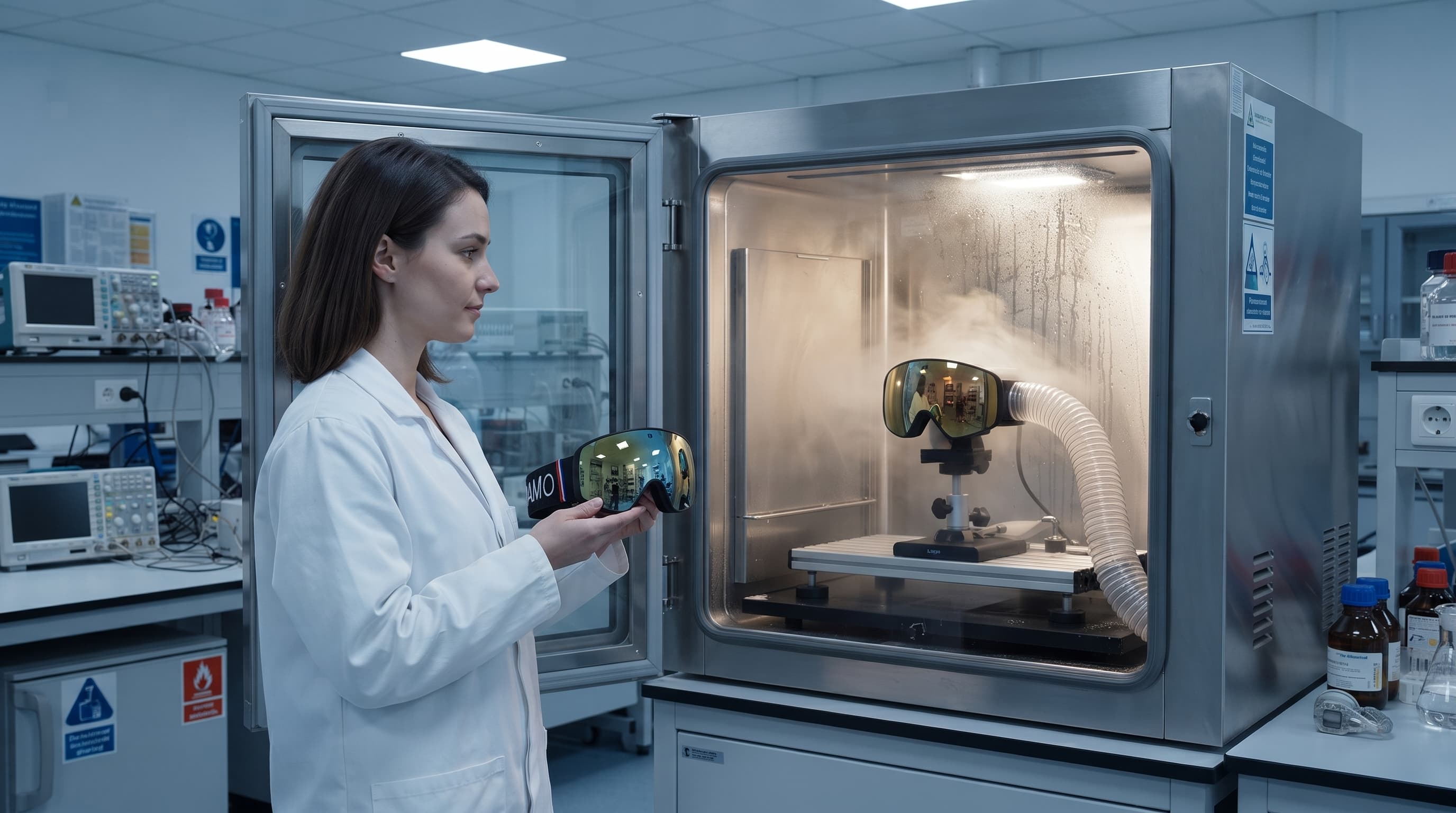
Lab methods explained: climatic chamber, Tyndall light test, EN 166 vs EN ISO 18527-1 standards. The Original result: over 35 seconds.
“**The short version:** Anti-fog performance is measured in accredited labs using a climatic chamber, warm humid air directed at a cold lens, and a stopwatch. General eye protection standard EN 166 sets a minimum of 8 seconds. The ski-goggle standard **EN ISO 18527-1** demands **at least 30 seconds**. The Original delivers **over 35 seconds on both lenses** — comfortably above the threshold. Here's how the test actually works, and why blowing on your lens in a shop tells you nothing.”
— The short version:
Why Standardised Testing Matters
You've seen it happen: someone pulls a new goggle out of the box, breathes onto the lens, nods approvingly, and declares it "good enough." This little ritual — the "breath test" — is about as reliable as diagnosing engine trouble by kicking the tyre. It is not standardised, not repeatable, and not measuring anything useful.
In an accredited laboratory, the anti-fog test follows a precise protocol: controlled temperature, controlled humidity, controlled airflow, timed to the second. No random breath, no variable angle, no luck. It is the only way to compare goggles objectively — and to know whether a model actually delivers what it claims.
The Lab Method: Climatic Chamber, Warm Air, Cold Lens
The Setup
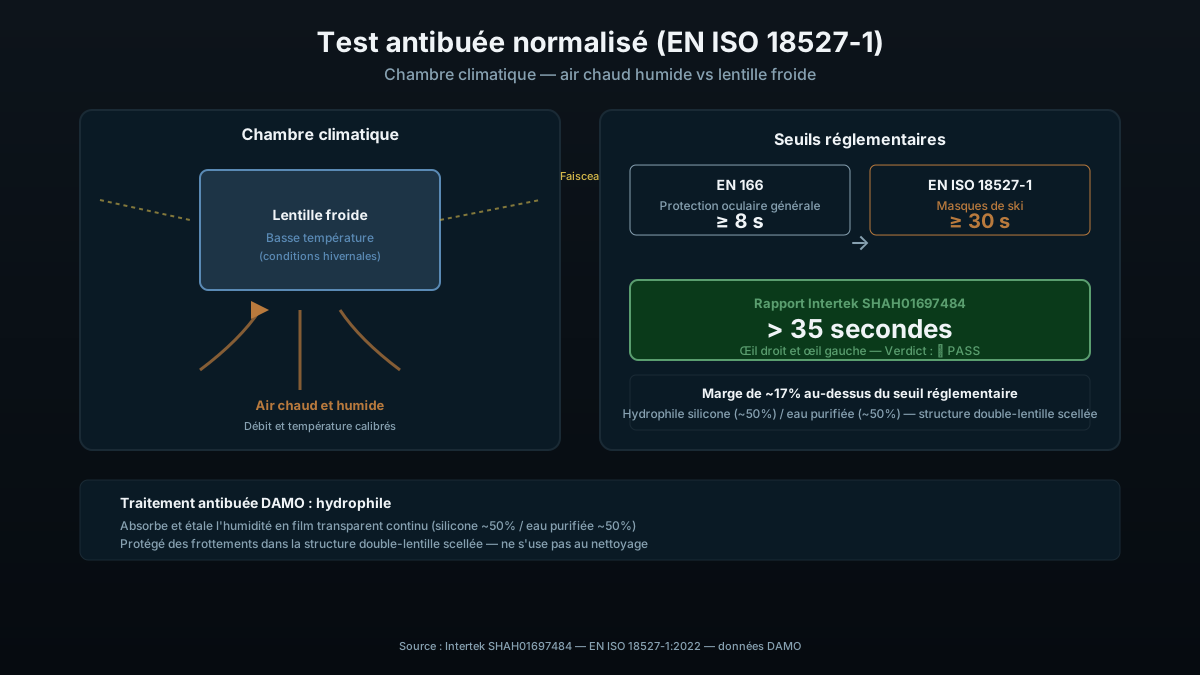
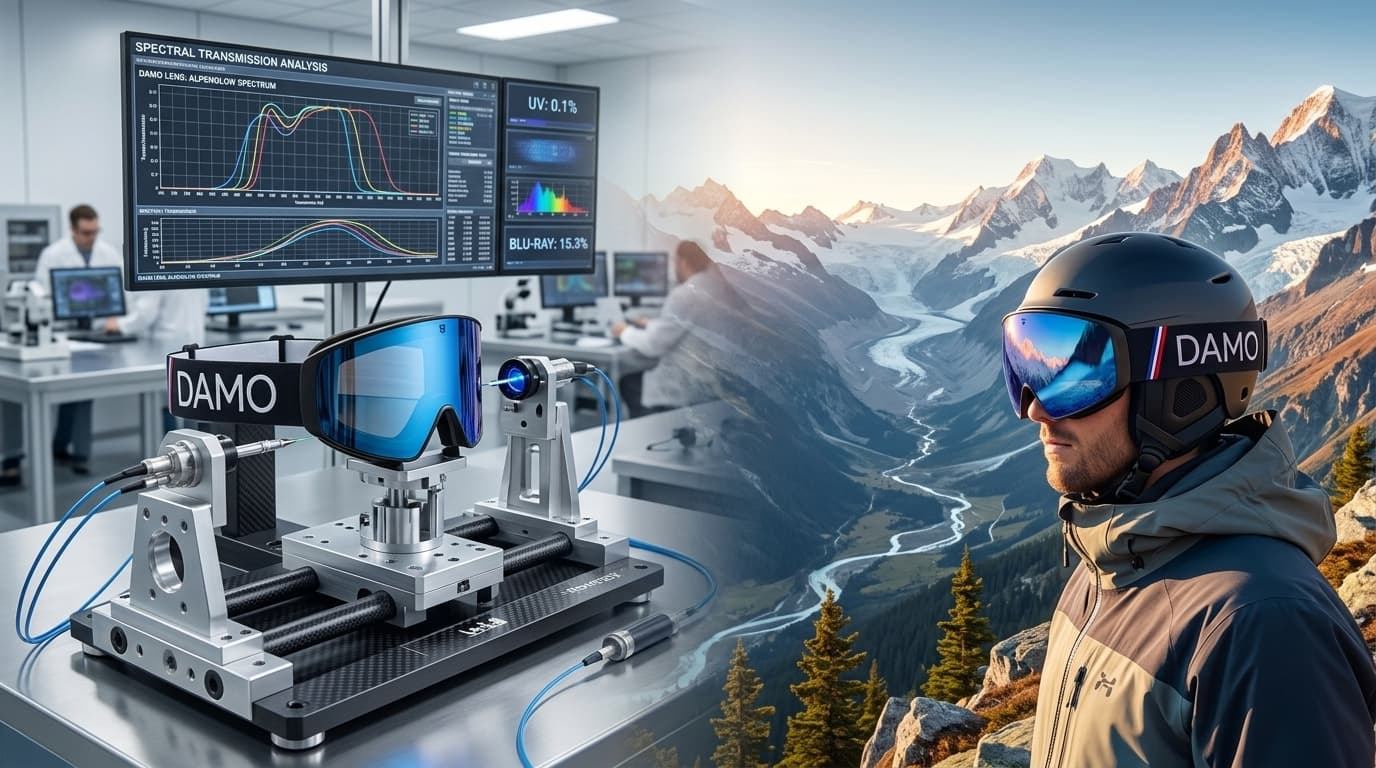
The lens is placed in a **climatic chamber** at low temperature (simulating winter conditions). A warm, humid air generator — set to a precise temperature and flow rate — is directed at the inner surface of the lens. The stopwatch starts.
The test measures the time until the first micro-droplets of condensation appear. No subjectivity, no "looks clear to me": a sensor or trained observer detects the exact moment when fogging starts to reduce light transmission.
The Tyndall Light Test
Before your eyes can perceive a white haze, the first droplets — at the micron scale — are already scattering light. The **Tyndall test** uses a collimated beam passing through the lens. As long as the lens is free of fog, the beam remains sharp and undiffused. The moment micro-droplets appear, the beam scatters. This early detection is far more precise than visual inspection, and it removes any subjectivity from the measurement.
The Thresholds: 8 Seconds vs 30 Seconds
| Standard | Anti-fog threshold | Context |
|---|---|---|
| **EN 166** (general eye protection) | ≥ 8 seconds | Generic standard for all protective eyewear |
| **EN ISO 18527-1** (ski & snowboard goggles) | ≥ 30 seconds | Goggle-specific, far more demanding |
EN 166 is the European baseline for eye protection in general (safety glasses, visors). Its 8-second threshold is relatively low — adequate for industrial settings where fogging is occasional.
The goggle-specific standard **EN ISO 18527-1:2022** requires **30 seconds minimum**. Why the gap? Because a skier breathes hard, generates a lot of moisture, and alternates between intense exertion and rest — far more aggressive conditions for an anti-fog treatment than a factory floor. A goggle that lasts 30 seconds in the lab stands a good chance of staying clear through an entire run.
The Original Result: > 35 Seconds
The **Intertek test report SHAH01697484** (CNAS-accredited lab — that matters) records:
- **Right eye:** > 35 seconds
- **Left eye:** > 35 seconds
- **Requirement:** ≥ 30 seconds
- **Verdict:** PASS
That is roughly 17 % above the standard, giving a comfortable margin. All Damo goggles — Pink, Blue, and Gold — share the same dual-lens construction and the same anti-fog treatment specification. The common design across the range means the result represents the lens system's performance.
“**Standard reference note:** The Intertek report cites **ISO/DIS 18527-1:2022**. The harmonised EU standard is EN ISO 18527-1:2022. The technical requirements are identical.”
— Standard reference note:
Hydrophilic vs Hydrophobic: Two Approaches
The anti-fog treatment used by Damo is **silicone-based hydrophilic**. In plain terms, it **absorbs** moisture and spreads it into a continuous transparent film rather than forming light-scattering droplets.
| Property | Hydrophilic (Damo) | Hydrophobic |
|---|---|---|
| Behaviour | Absorbs and spreads water into a continuous film | Beads and rolls water off (lotus effect) |
| Active compounds | Silicone ~50 %, purified water ~50 % | Fluorinated compounds or silanes |
| Durability when sealed | Excellent (protected from abrasion) | Variable, degrades faster |
| Cleaning | Do not rub — the film can be damaged | Same |
The Damo treatment is applied to the **inner surface of the inner (CA) lens**, inside the **sealed dual-lens structure**. This is a fundamental advantage: because the inner lens never touches a cloth, a tongue, or fingers, the treatment is not degraded by cleaning. In a single-lens system, every cleaning wears the anti-fog layer a little more — here, it is protected.
Why the Sealed Dual Lens Changes Everything
The dual-lens structure isn't just about thermal comfort (more on that in Article 10). It also **physically protects** the anti-fog treatment.
In a single-lens goggle, the anti-fog surface is exposed — to your breath, your fingers, the cloth, splashes. It degrades progressively. After a season, it may last only a few seconds.
In The Original, the anti-fog layer is sandwiched between the outer polycarbonate lens and the inner cellulose acetate lens. You cannot reach it. You cannot wear it out by rubbing. Its lifespan is that of the seal that holds the assembly together — far longer.
FAQ
Is the home "breath test" worth anything?
No. It is not standardised, it depends on your breath temperature, its humidity, the angle, the distance. The same goggle can "pass" or "fail" depending on how you breathe on it. Labs use calibrated climatic chambers and precisely controlled airflow for a reason: to make the test repeatable and objective.
Is 35 seconds good or average in the industry?
It is solid. The regulatory minimum is 30 seconds. Many entry-level goggles scrape just past 30 seconds. The best premium goggles reach 60–77 seconds. Damo sits in the upper-middle tier — comfortably above the threshold, without reaching the extreme values of the most expensive models.
Does the anti-fog treatment wear out over time?
In a sealed dual-lens system, the treatment itself does not wear out because it never contacts anything. What can degrade is the seal: if the seal is compromised (impact, extreme heat, ageing), humid air can enter the sealed cavity and fogging becomes permanent. Never try to separate the two lens layers.
Can I improve anti-fog with an aftermarket spray?
Not recommended on a dual-lens goggle. Aftermarket sprays often contain compounds that can attack the seal or the existing treatment. Use only water and the provided microfiber cloth. If the original treatment no longer performs (after several seasons), replace the lens — don't spray.
What is the difference between EN 166 and EN ISO 18527-1 for fogging?
EN 166 sets an **8-second minimum** for all protective eyewear. EN ISO 18527-1 requires **30 seconds** specifically for ski goggles. A goggle certified to EN 166 alone is not necessarily suitable for skiing — always check the goggle standard.
Sources
- Intertek Testing Services — Test Report SHAH01697484, CNAS-accredited
- EN ISO 18527-1:2022 — Requirements for downhill skiing and snowboarding goggles
- EN 166:2002 — Personal eye protection. Specifications.
- Out Of — "How Do You Really Test Anti-Fog Performance?" [out-of.com](https://out-of.com/tech-pills-anti-fog)
- Brass Knuckle Protection — EN 166 test data. [brassknuckleprotection.com](https://www.brassknuckleprotection.com/brass-knuckle-anti-fog-technologies)
- Alpenglow Adventure Sports — "Ski Goggle Technology Explained: Lens Types, Anti-Fog Systems, and Fit Guide" [alpenglowgear.com](https://alpenglowgear.com)
- [DAMO SUPPLIER DATA] — The Original: components and anti-fog treatment.
- ISO 18526-2:2020 — Test methods. Physical optical properties.
*Published August 28, 2026 — Category: Lens Science (SCI)*
The DAMO goggle — two lenses included, €80 on preorder
Sealed double anti-fog lens, magnetic interchangeable lens system, and a free yellow fog lens. Free shipping in France.
Visit the shopRelated articles
2026-08-28
What Is VLT in Ski Goggles? Complete S0–S4 Guide
Everything you need to know about VLT (Visible Light Transmission) and S0–S4 filter categories for ski goggles: EN ISO 18527-1 standard, spectrophotometry, worked examples with DAMO lens values.
2026-08-28
UV Protection in Ski Goggles: The Complete Guide
Complete guide to UV protection in ski goggles: UV400, ISO 18527-1 standards, altitude effects, myths debunked, and what to look for when buying.
2026-08-28
Lab Tests vs Real Slopes: What Certifications Don't Tell You
Lab tests prove safety. They don't prove a goggle will perform on the mountain. Here's what certifications really measure — and what they leave out.