Lab Tests vs Real Slopes: What Certifications Don't Tell You
Lab tests prove safety. They don't prove a goggle will perform on the mountain. Here's what certifications really measure — and what they leave out.
**The short version:** Lab tests — impact, UV, VLT, anti-fog — are the regulatory bedrock for selling ski goggles in Europe. They certify that a product meets minimum safety thresholds under controlled conditions. But a "certified" goggle isn't necessarily the best one for your face, your conditions, or your riding style. This article breaks down what the standards actually measure — and what they can't.
What Lab Testing Confirms
Standardized tests cover eight areas that matter for safety and baseline performance.
1. Optical Safety — Your Lens Is Neutral
A goggle lens must be effectively plano (zero corrective power). EN ISO 18527-1 requires spherical power ≤ ±0.12 m⁻¹ and astigmatic power ≤ 0.12 m⁻¹. Exceed those limits and you risk eye strain and headaches.
2. UV Protection — The Real Shield
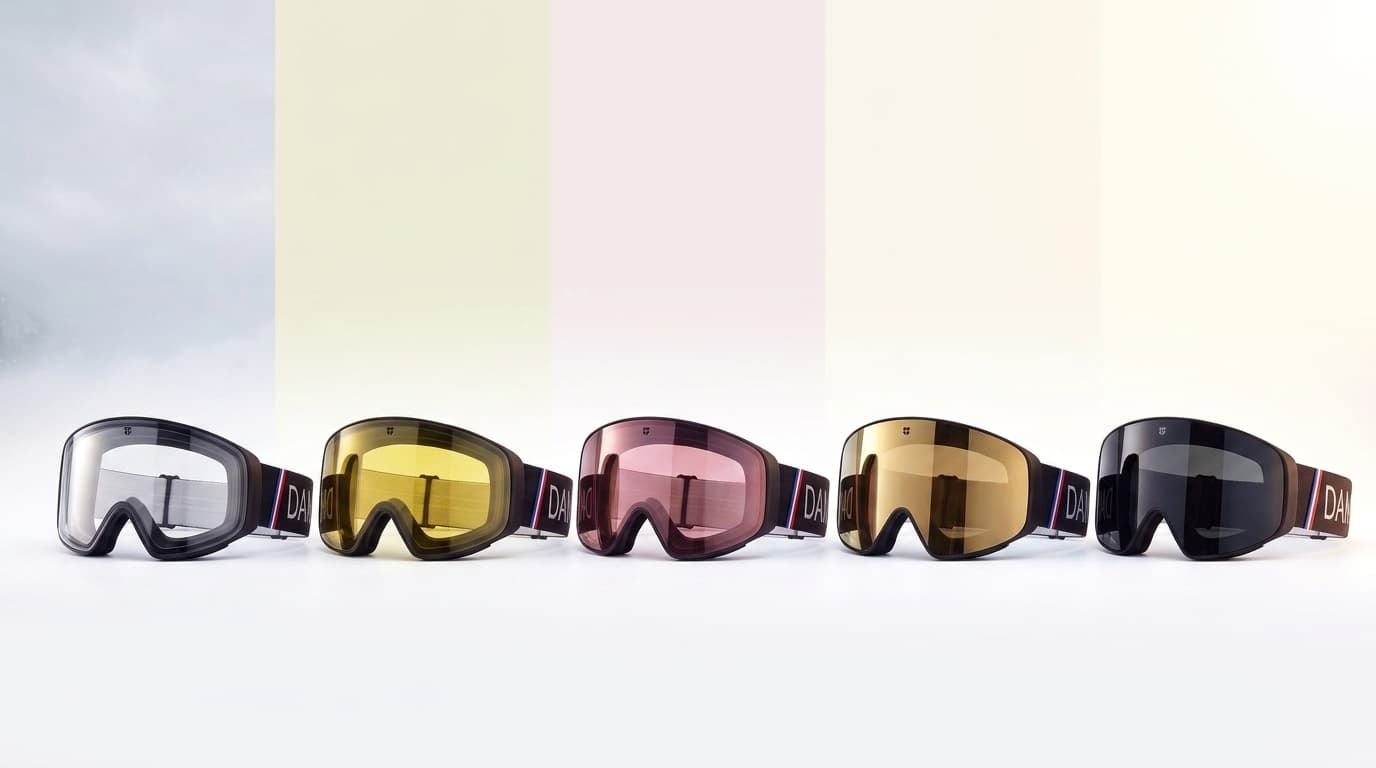
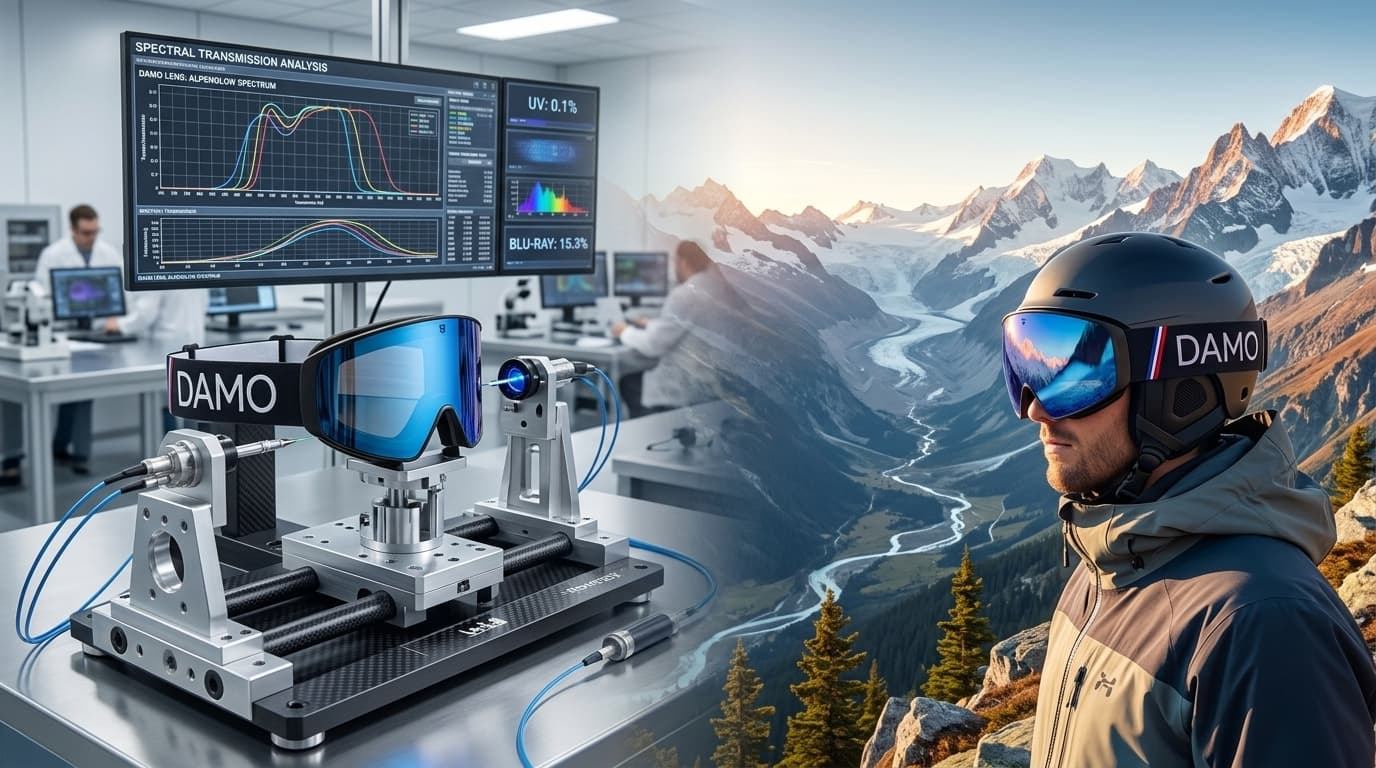
A spectrophotometer scans across 280–780 nm. The standard mandates near-total blocking of UV-B (280–315 nm), UV-A (315–380 nm), and up to 400 nm. DAMO's three lens variants (Pink, Blue, Gold) all measure 0.00 % UV-B and UV-A transmission in supplier testing.
3. VLT Category — The One Number to Know
Visible Light Transmission is measured using D65 daylight illuminant. It's what sorts lenses into S0–S4 categories. All three DAMO lenses are S3 (8–18 % VLT), the most common category for resort skiing.
4. Uniformity — Both Eyes See the Same Thing
The transmittance difference between left and right lenses must be ≤ 15 %. Beyond that, your brain compensates — causing asymmetric contrast perception and depth errors. DAMO lenses pass with margins ranging from 0.08 % to 3.96 %.
5. Impact Resistance
A 43 g steel ball is dropped from 130 cm at -10 °C. The goggle must stay on the headform, the lens must not be penetrated, and the frame must not shatter.
6. Anti-Fog Baseline
The assembled goggle faces warm, humid airflow and must resist condensation for at least 30 seconds. The lab test doesn't simulate a season of use, but it establishes a minimum. DAMO's The Original test result: > 35 seconds.
7. Spectral Aging (UV Resistance)
The lens is exposed to a 450 W xenon lamp in an accelerated cycle. Transmittance must not shift by more than 8 %. This ensures the lens won't yellow or degrade optically after a few weeks in sunlight.
8. Field of View
Minimum requirements: 60° temporal, 30° nasal, 30° superior, 30° inferior. DAMO goggles exceed 35° on both inferior and superior fields.
What Lab Testing Cannot Prove
Here's where the fine print matters more than the certificate.
Real-World Anti-Fog Durability Over Months
The lab runs one cold→warm cycle. It doesn't predict behaviour after 50 temperature cycles, a season of sweat exposure, or seal fatigue between the two lens layers.
Fog During Specific Exertion Patterns
The lab uses steady-state warm airflow. Not hiking breath, not post-sprint panting, not varied respiration rates.
Mirror Coating Abrasion After 100+ Cleanings
Abrasion resistance (clause 14.3) is optional under EN ISO 18527-1. Many suppliers don't claim it. No standardised test tracks what mirror coatings look like after a season of wiping.
Ventilation System Performance
How frame vents interact with your helmet, strap tension, and crosswind is unique to your face shape and gear — it can't be standardised.
Colour Perception in Variable Natural Light
The VLT measurement uses a standard laboratory illuminant (D65). Real mountain light changes with elevation, cloud cover, tree cover, and time of day. Subjective colour rendering — that "pop" skiers look for — is measured by no standard.
Helmet/Goggle Interface Fit
Standard headforms (ISO 18526-4) don't cover all face shapes, nose bridges, or cheekbone profiles. Fit is deeply personal.
Frame Flex at Extreme Cold (-30 °C vs -10 °C)
The standard test temperature is -10 °C. Extended low-temperature testing (clause 14.1) is optional. DAMO doesn't claim it.
Subjective Contrast Enhancement
The feeling that a lens "makes the terrain pop" is very real — and very personal. It's entirely out of scope for any standard. Yet it's often what separates a lens you love from one you tolerate.
What This Means for You as a Buyer
"Certified" ≠ "Best"
A goggle that barely passes (say, 31 seconds anti-fog) carries the same "certified" label as one scoring 77 seconds. The pass/fail mark doesn't distinguish minimum compliance from excellence.
Lab Conditions Are Controlled; Slopes Are Chaotic
Wind changes the thermal gradient. Fast descents create forced airflow that can accelerate drying — or cause evaporative cooling that refreezes condensation. The lab can't model this complexity.
EN ISO vs ASTM: Know the Difference
A goggle certified to EN ISO 18527-1 (Europe) is not automatically compliant with ASTM F659 (US), and vice versa. If you ski in both regions, check which standard applies.
"Made in China" ≠ Lower Quality
Intertek-accredited labs in Wenzhou — where DAMO's supplier is based — hold CNAS and IAS accreditation. The test methods and pass criteria are identical regardless of geography. A test performed in China is no more or less stringent than one performed in Germany.
FAQ
**Q: Does a goggle that passes all tests guarantee good quality?** A: Not necessarily. "Pass" means meeting a minimum threshold. Some goggles excel with wide margins; others scrape by. Look at the numbers, not just the label.
**Q: Are European and US standards interchangeable?** A: No. EN ISO 18527-1 and ASTM F659 differ on projectile mass, drop height, chemical resistance, and other requirements. Check which standard applies in your market.
**Q: Can I trust the "breath test" to check anti-fog?** A: No. Blowing on a lens is not standardised, not repeatable, and has no regulatory value. It can also damage the anti-fog coating.
**Q: How do I know a lens is truly UV400?** A: Check the manufacturer's test results (UV-B and UV-A transmission). The "UV400" label alone isn't regulated — the numbers are.
**Q: Why can two certified goggles feel completely different on snow?** A: Because standards don't cover subjective colour rendering, fit comfort, or frame behaviour at low temperatures. Those differences are real — and they aren't tested.
Sources
- EN ISO 18527-1:2022 — Requirements for downhill skiing and snowboarding goggles (https://www.iso.org/standard/62788.html)
- Intertek SHAH01697484 — Test report (DAMO) [internal supplier report]
- QIMA — "Sports Eyewear Testing – IAS and CNAS Accredited Labs" (https://www.qima.com/consumer-products/lab-testing/sports-eyewear-goggles)
- Out Of — "How Do You Really Test Anti-Fog Performance?" (https://out-of.com/tech-pills-anti-fog)
- OutdoorGearLab — "How We Tested Ski Goggles" (https://www.outdoorgearlab.com/topics/snow-sports/best-ski-goggles)
- Treeline Review — "6 Best Ski Goggles of 2026" (https://www.treelinereview.com/gearreviews/best-ski-goggles)
- REI Co-op — "Snow Goggle Lens Colors Explained" (https://www.rei.com/blog/snowsports/understanding-goggle-lens-colors)
- ISO 18526-1/2/3:2020 — Test methods for optical and physical properties
**Related articles:** [How to Choose Ski Goggles](/en/blog/how-to-choose-ski-goggles) · [Cylindrical vs Spherical vs Toric Lenses](/en/blog/lens-shape-guide) · [UV Protection in Ski Goggles: The Complete Guide](/en/blog/uv-protection-guide) · [DAMO vs Julbo](/en/blog/damo-vs-julbo) · [How to Clean Ski Goggle Lenses](/en/blog/clean-care-goggle-lenses)
The DAMO goggle — two lenses included, €80 on preorder
Sealed double anti-fog lens, magnetic interchangeable lens system, and a free yellow fog lens. Free shipping in France.
Visit the shop