How to Read a Ski Goggle Test Report: What the Numbers Actually Mean
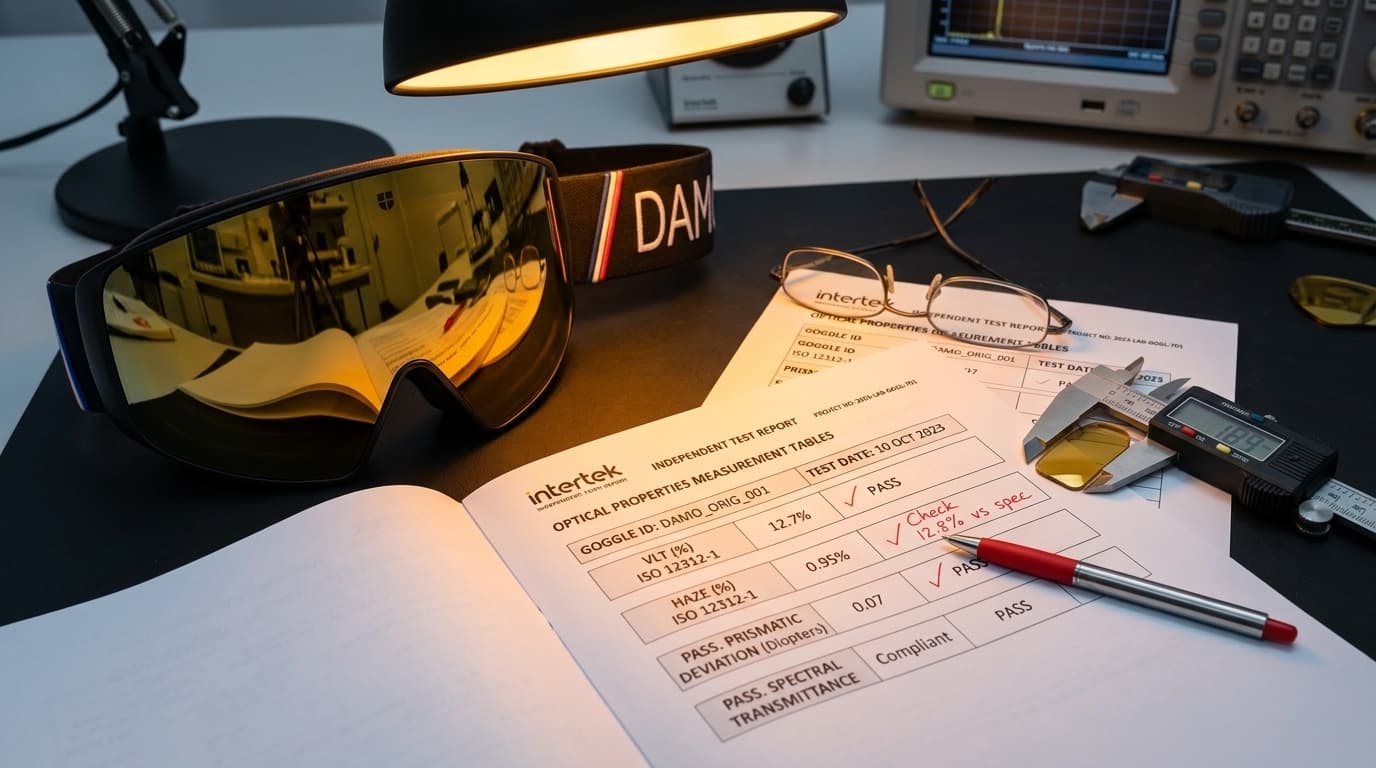
Line-by-line walkthrough of the Intertek report for the Damo reference model The Original: spherical power, prism, scattered light, UV, anti-fog, field of view. And the trap to avoid: 'Pass' does not mean 'excellent'.
“**The short version:** A lab test report contains dozens of measurements, but most consumers don't know how to interpret them. "Pass" simply means the result meets or exceeds the regulatory minimum — it does not mean the result is excellent. Using the Intertek report SHAH01697484 for The Original, this article walks through every key metric: spherical power, prism, scattered light, UV, anti-fog, field of view. Here is how to read the numbers, not the marketing claims.”
— The short version:
The "Certificate" Obsession
In the ski goggle world, everyone waves "test reports" and "certifications." But very few people take the time to explain what these documents actually contain. A test report is not a magic stamp — it is a collection of precise measurements, each compared against a regulatory limit.
Here is how to read yours.
The Intertek Report SHAH01697484: Line by Line
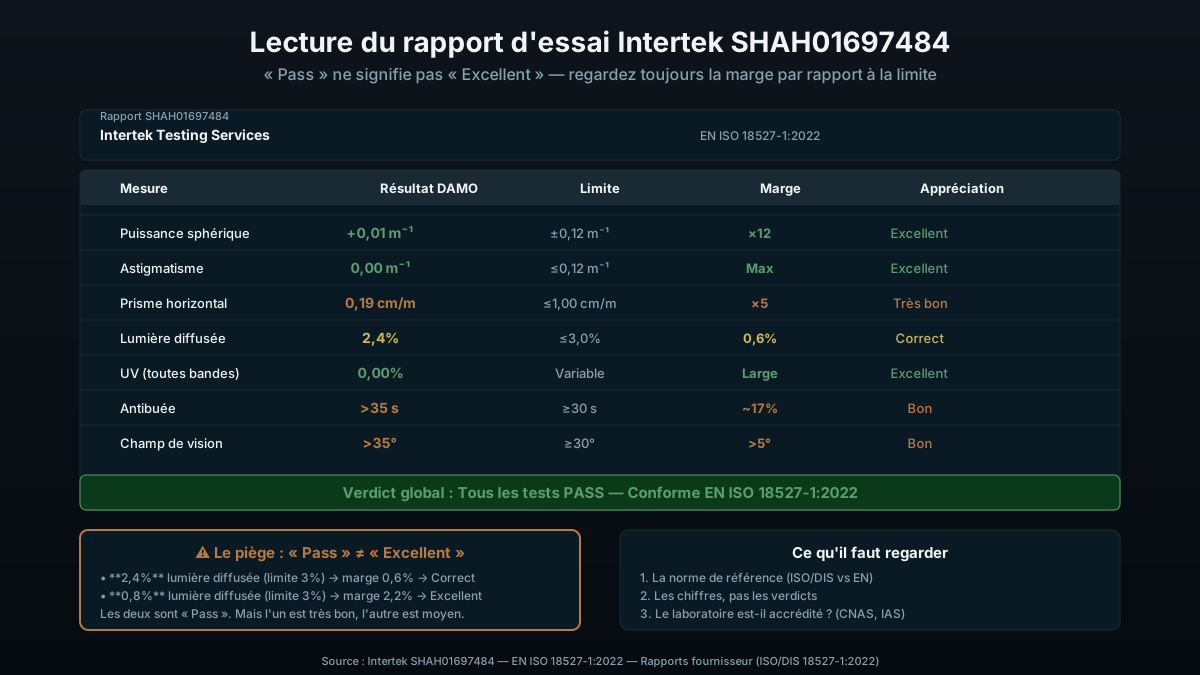
**Intertek Testing Services** (Wenzhou, China, CNAS-accredited) tested the reference The Original model under clauses of **EN ISO 18527-1:2022** noting that the report also references ISO/DIS 18527-1:2022. Here is what each measurement means.
1. Spherical Power: +0.01 m⁻¹
**Limit:** ≤ ±0.12 m⁻¹ **Damo result:** +0.01 m⁻¹ (both eyes) **Verdict:** ✅ PASS
Spherical power measures whether the lens acts like a corrective lens. A ski goggle must be **plano** — no correction — since the wearer may use their own glasses or contact lenses underneath.
A result of +0.01 m⁻¹ is very low. The limit allows ±0.12 m⁻¹ — twelve times higher. The Damo lens is optically neutral to a level far exceeding the minimum requirement. This is a sign of precision moulding.
2. Astigmatic Power: 0.00 m⁻¹
**Limit:** ≤ 0.12 m⁻¹ **Damo result:** 0.00 m⁻¹ **Verdict:** ✅ PASS
Optical astigmatism (cylindrical power) measures whether the lens distorts images by favouring one axis. A result of 0.00 m⁻¹ means **no measurable distortion** on this sample.
This is a strong result, indicating very good moulding and polishing quality. Astigmatism below 0.02 m⁻¹ is characteristic of well-manufactured lenses.
3. Prism Imbalance: 0.19 cm/m (horizontal, base out)
**Horizontal base out limit:** ≤ 1.00 cm/m **Vertical limit:** ≤ 0.25 cm/m **Damo result:** 0.19 cm/m horizontal, 0.00 cm/m vertical **Verdict:** ✅ PASS
Prism imbalance measures whether the two lenses deviate light differently. If the offset is too large (above 1 cm/m horizontal), the brain receives two slightly shifted images — causing **double vision, eye strain, and headaches**.
Damo's 0.19 cm/m is well within the limit. At 0.19 cm/m, the offset is imperceptible. The 0.25 cm/m vertical limit is not even approached (0.00).
4. Scattered Light: 2.4 %
**Limit:** ≤ 3 % **Damo result:** 2.4 % (both eyes) **Verdict:** ✅ PASS
Scattered light — or veiling glare — measures the percentage of light that passes through the lens diffused rather than transmitted straight. Excessive scatter reduces contrast and creates a veil effect, particularly dangerous in **flat light** where terrain features depend on subtle contrast differences.
The 2.4 % result is acceptable, but it is the metric with the narrowest margin. It passes comfortably — the limit is 3 % — though it is not the most outstanding value in the report. Most quality goggles seen in published reviews typically fall between 1.5 % and 2.5 % on this metric.
5. UV Transmittance: 0.00 %
**Limit:** varies by category (UV-B ≤ 0.03 × τv, UV-A ≤ 0.15 × τv for S3) **Damo result:** 0.00 % UV-B, 0.00 % UV-A, ≤ 0.05 % 380–400 nm **Verdict:** ✅ PASS
The goggle blocks **100 % of measurable UV-B and UV-A** on this sample. Transmission in the 380–400 nm band is below 0.05 % — effectively zero. Well-manufactured polycarbonate lenses with UV stabilisers consistently achieve these levels; the result confirms Damo meets this essential safety baseline.
“**Important point:** UV protection does not depend on tint colour. A clear lens can block 100 % of UV, and a very dark lens can let UV through. Always check the measurement, not the colour.”
— Important point:
6. Anti-Fog: > 35 Seconds
**Limit:** ≥ 30 seconds **Damo result:** > 35 s (both eyes) **Verdict:** ✅ PASS
See Article 09 for the full breakdown. The result exceeds the threshold by roughly 17 %, providing a comfortable margin without reaching the top tier (some premium goggles achieve 60–77 seconds).
7. Field of View: > 35° Inferior and Superior
**Limit:** ≥ 30° (inferior, superior, nasal) **Damo result:** > 35° (inferior and superior) **Verdict:** ✅ PASS
Field of view measures the angular range you can see without turning your head. Narrow field limits peripheral awareness — dangerous in skiing where other skiers, branches, and terrain features appear to the side.
Damo exceeds the 30° requirement by more than 5°. This is a good result for a dual-lens goggle (the structure tends to reduce field compared to a single lens).
The Trap: "Pass" Does Not Mean "Excellent"
This is the most common mistake: seeing "Pass" in every box feels reassuring. But a test report does not distinguish between:
- **2.4 %** scattered light (limit: 3 %) → margin of 0.6 %
- **0.8 %** scattered light (limit: 3 %) → margin of 2.2 %
Both are "Pass." But one is very good, the other is average.
Here is our reading guide for the Damo report:
| Measurement | Result | Limit | Margin | Assessment |
|---|---|---|---|---|
| Spherical power | 0.01 m⁻¹ | 0.12 m⁻¹ | ×12 | Excellent |
| Astigmatism | 0.00 m⁻¹ | 0.12 m⁻¹ | Max | Excellent |
| Horizontal prism | 0.19 cm/m | 1.00 cm/m | ×5 | Very good |
| Scattered light | 2.4 % | 3.0 % | 0.6 % | Acceptable |
| UV (all bands) | 0.00 % | varies | Wide | Excellent |
| Anti-fog | > 35 s | 30 s | ~17 % | Good |
| Field of view | > 35° | 30° | > 5° | Good |
What to Look For on a Report
- **The reference standard** — ISO/DIS, EN, ASTM? The standard determines the limits. A report without a standard reference is worthless.
- **The numbers, not the verdicts** — "Pass" does not discriminate. Look at the gap from the limit.
- **The date** — a 2019 report proves nothing for a 2026 product.
- **The lab** — is it accredited? (CNAS, IAS, ISO 17025 — verifiable)
- **The tested sample** — the report tests one specific sample, not every unit in production. Series production may differ.
The ISO/DIS Caveat
Damo's reports reference **ISO/DIS 18527-1:2022**. The harmonised EU standard is **EN ISO 18527-1:2022**, whose technical requirements are identical.
These figures are **reliable technical data**.
FAQ
Can I compare two goggles by looking at their test reports?
Yes — provided they were tested to the **same standard** by accredited labs. Compare raw numbers, not verdicts. A goggle with 0.8 % scattered light is objectively better than one with 2.4 % — even though both are "Pass."
Is a spherical power of 0.05 m⁻¹ a problem?
No. The limit is 0.12 m⁻¹. 0.05 m⁻¹ is well below and perfectly acceptable. Most people cannot perceive any difference until about 0.08 m⁻¹. Damo's 0.01 m⁻¹ is excellent, but 0.05 m⁻¹ is already very good.
What does "Pass" actually mean in a report?
"Pass" means the measurement meets the regulatory limit. It is neither a medal nor a promise of performance in all conditions. A report does not cover durability, colour rendition, or fit comfort.
Why do some reports not measure anti-fog?
Anti-fog is mandatory in EN ISO 18527-1 for ski goggles, but not in all standards (EN 166, for example, does not require it for some categories). Check that the report covers the anti-fog clause before buying.
Is a report from a Chinese lab reliable?
Yes, if the lab is accredited. Intertek Wenzhou is CNAS-accredited, and CNAS is a signatory to the ILAC mutual recognition arrangement. The test methods and criteria are the same regardless of geography.
Sources
- Intertek Testing Services — Test Report SHAH01697484, CNAS-accredited, Wenzhou, China.
- EN ISO 18527-1:2022 — Requirements for downhill skiing and snowboarding goggles.
- ISO 18526-1:2020 — Test methods. Geometrical optical properties.
- Supplier optical reports for The Original.
- 14-product-spec-lenses.md — Damo product specification document, §8 Compliance status.
- Out Of — "What Lab Tests Cannot Simulate." [out-of.com](https://out-of.com/tech-pills-anti-fog)
*Published August 28, 2026 — Category: Lens Science (SCI)*
The DAMO goggle — two lenses included, €80 on preorder
Sealed double anti-fog lens, magnetic interchangeable lens system, and a free yellow fog lens. Free shipping in France.
Visit the shopRelated articles
2026-08-28
What Is VLT in Ski Goggles? Complete S0–S4 Guide
Everything you need to know about VLT (Visible Light Transmission) and S0–S4 filter categories for ski goggles: EN ISO 18527-1 standard, spectrophotometry, worked examples with DAMO lens values.
2026-08-28
UV Protection in Ski Goggles: The Complete Guide
Complete guide to UV protection in ski goggles: UV400, ISO 18527-1 standards, altitude effects, myths debunked, and what to look for when buying.
2026-08-28
Lab Tests vs Real Slopes: What Certifications Don't Tell You
Lab tests prove safety. They don't prove a goggle will perform on the mountain. Here's what certifications really measure — and what they leave out.