Ski Goggle Lens Tint Guide — Which Colour for Which Condition?
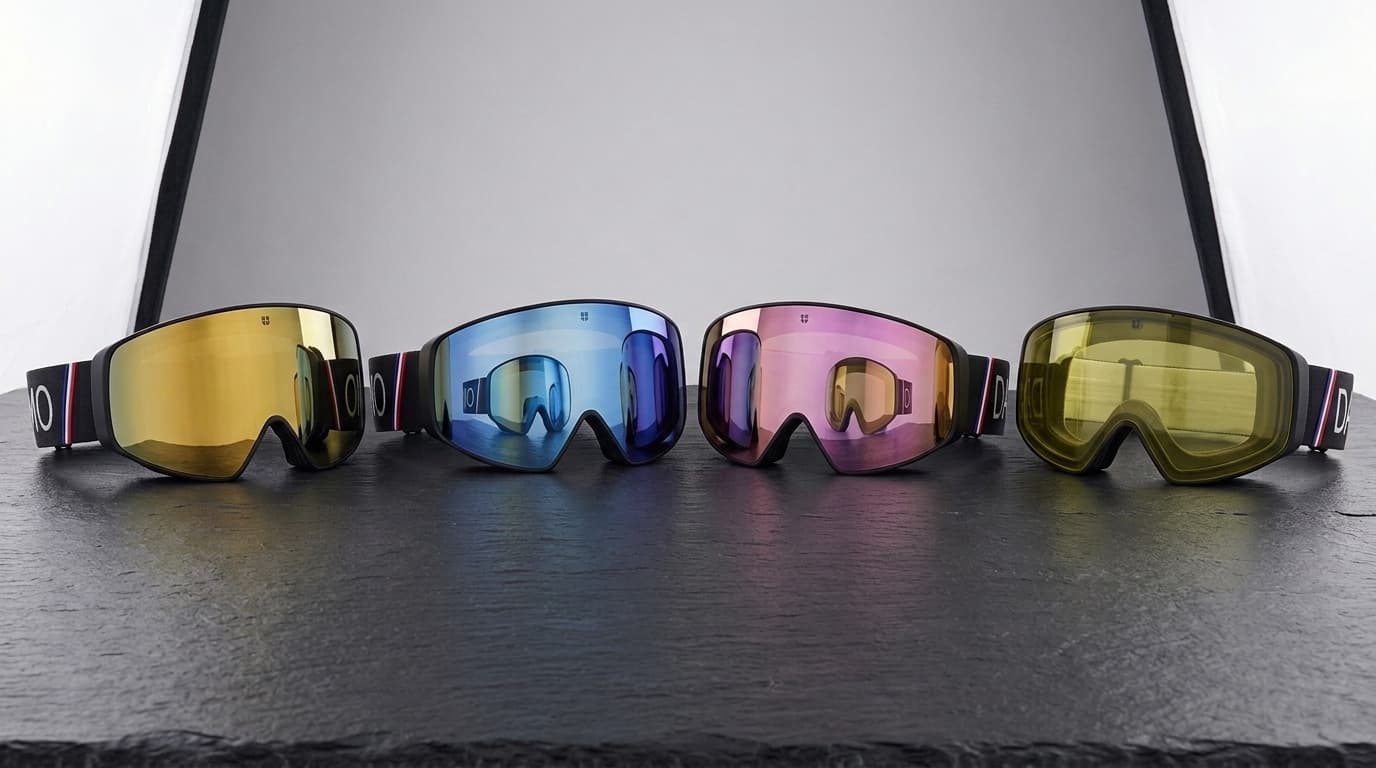
Rose, blue, gold, yellow, silver: each lens tint serves a specific purpose. This guide helps you choose the right colour for snow conditions and light levels.
**The short version:** A lens tint doesn't change its VLT category (S0–S4), but it determines how your eye perceives contrast on snow. Each colour filters specific wavelengths to improve visibility in different conditions. Here's how to choose — and why a two-lens system (S3 + S1) is the most versatile setup you can buy.
Tint Colour Reference Table
| Tint | Best Conditions | Visual Effect |
|---|---|---|
| **Rose / Pink** | Overcast, flat light | Warms the spectrum, boosts red/brown contrast against white — reveals terrain contours |
| **Blue** | Moderate to bright sun | Neutral colour balance, reduces overall brightness |
| **Gold / Copper** | Variable to flat light | Blocks blue/violet (scattered by snow), enhances greens and ambers — best contrast enhancer |
| **Yellow** | Flat light, storm, night skiing | Maximum contrast amplification. Blocks blue, lets nearly everything else through |
| **Silver / Chrome** | Full sun (mirror) | Neutral, very low VLT, maximum glare reduction |
| **Green** | Medium brightness | Enhances contrast while keeping natural colour balance |
| **Red / Orange** | Variable cloud | Works well in mixed sun/cloud |
| **Clear** | Night / indoor | Zero tint, maximum light transmission |
S3 (8–18 % VLT) — The Resort Standard
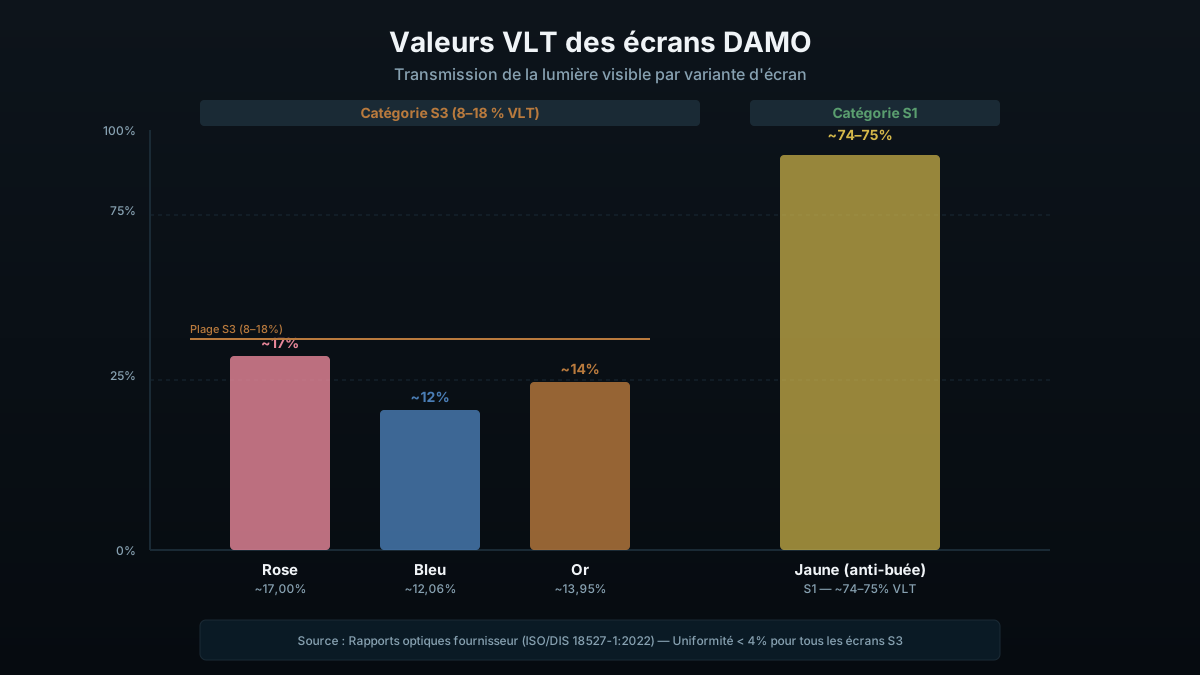
All three DAMO launch lenses (Pink, Blue, Gold) are S3. This is the most common category for resort skiing — and for good reason. Between 9 am and 4 pm in winter, even under partly cloudy skies, snow reflection is intense. S3 offers the right balance of protection and visibility.
The tint is where the real difference lives:
- **Pink:** Excellent in overcast or flat light. Pink warms the visual scene and pulls out micro-relief — ideal when snow and sky blur into one grey sheet.
- **Blue:** Neutral, pleasant in moderate sun. Preserves natural colour perception.
- **Gold:** The best contrast enhancer. It cuts blue scattered light and boosts warm tones. Perfect for changeable conditions.
How to Choose by Condition
Full sun (bluebird, brilliant snow)
→ **S3 to S4**, neutral or mirror tint (silver, dark blue). You're reducing brightness, not boosting contrast.
Partly cloudy
→ **S2 to S3**, rose, copper or gold for contrast. Light changes every 10 minutes — a good mid-range VLT with contrast boost smooths the transitions.
Overcast or snowing
→ **S1 to S2**, yellow, rose or high-contrast tint. In flat light, priority is recovering definition. Yellow is ideal because it maximises contrast without darkening.
Night skiing
→ **S0** (clear) or very light S1. You need every photon you can get.
The recommended strategy: two lenses
A two-lens system covers virtually every situation:
- **Primary lens: S3** (rose, blue or gold depending on preference) for sunny to variable days.
- **Secondary lens: S1 yellow** for fog, snow, late afternoon, and days without sun.
This is exactly DAMO's approach: every goggle ships with a tinted S3 lens AND a yellow S1 fog lens. You don't choose between them — you carry both.
Rose vs Yellow: The Two Contrast Champions
These two tints deserve special attention because they're the ones most requested by skiers riding in European conditions (where weather changes fast at altitude).
**Rose / Pink:** Best for flat-light conditions — uniform snow, grey sky, no shadows. Pink warms the visual field and reveals contours the naked eye cannot see. If you ski mostly on-piste under variable skies, this is your tint.
**Yellow:** The low-light king. In thick fog or a snowstorm, yellow maximises every bit of available contrast. DAMO's S1 yellow lens transmits ~75 % of light — nearly like skiing without a lens, but with a huge contrast boost. Reach for it as soon as the sun drops.
Quick Heuristics
- Bluebird → S3 or S4, mirror if possible
- Cloudy → S2–S3 rose or copper
- Fog / snow → S1 yellow
- Late afternoon → S1 rose or yellow
- Night → S0 clear
- "One lens for everything" → S2 rose or copper (compromise)
- "I want to be ready for anything" → S3 + S1 (the DAMO solution)
FAQ
**Q: What's the difference between tint and VLT category?** A: The category (S3, S1…) determines how much light gets through. The tint (rose, blue, gold…) determines which wavelengths are filtered to improve contrast. They're independent.
**Q: Is pink lens only for girls?** A: No — pink is a functional colour that warms the light spectrum. It's used by skiers of all levels to boost contrast in flat light.
**Q: Can I use an S4 lens for resort skiing?** A: Technically yes, comfortably no. S4 (3–8 %) is very dark — reserved for glaciers or extreme sun. In ordinary resort conditions you'll be taking the goggle off in every shaded section.
**Q: Is yellow lens only for night skiing?** A: Common misconception. Yellow is excellent in overcast conditions, fog, and snowfall — not just at night. It amplifies contrast regardless of ambient brightness.
**Q: Do snowboarders need different tints than skiers?** A: No. The optical requirements are the same. Some riders prefer a wider field of view, but the tint and VLT choices are identical.
Sources
- REI Co-op — "Snow Goggle Lens Colors Explained" (https://www.rei.com/blog/snowsports/understanding-goggle-lens-colors)
- Bold Outdoorwear — "Ski Goggle Lens Tint Guide"
- ZIONOR — "How to Choose Ski Goggle Lens Color" (https://zionor.com/blogs/your-exercise-expert/ski-goggles-lens-color-analysis-what-color-is-right-for-what-weather)
- ShadyVEU — "Ski Goggle Lens Tint Color Guide" (https://shadyveu.com/blogs/news/ski-goggle-lens-color-guide)
- Montec — "Ski Goggle Lens Tint Guide"
**Related articles:** [Ultimate Guide to Ski Goggle Lens Technology](/en/blog/lens-technology-guide) · [Ski Goggle Fit Guide](/en/blog/ski-goggle-fit-guide) · [Magnetic vs Clip-In Lens Systems](/en/blog/magnetic-vs-clip-lens) · [DAMO vs Oakley: Lens Technology Compared](/en/blog/damo-vs-oakley) · [DAMO vs Bollé](/en/blog/damo-vs-bolle)
The DAMO goggle — two lenses included, €80 on preorder
Sealed double anti-fog lens, magnetic interchangeable lens system, and a free yellow fog lens. Free shipping in France.
Visit the shopRelated articles
2026-08-28
What Is VLT in Ski Goggles? Complete S0–S4 Guide
Everything you need to know about VLT (Visible Light Transmission) and S0–S4 filter categories for ski goggles: EN ISO 18527-1 standard, spectrophotometry, worked examples with DAMO lens values.
2026-08-28
UV Protection in Ski Goggles: The Complete Guide
Complete guide to UV protection in ski goggles: UV400, ISO 18527-1 standards, altitude effects, myths debunked, and what to look for when buying.