How to Choose Ski Goggles — Complete Step-by-Step Guide 2026
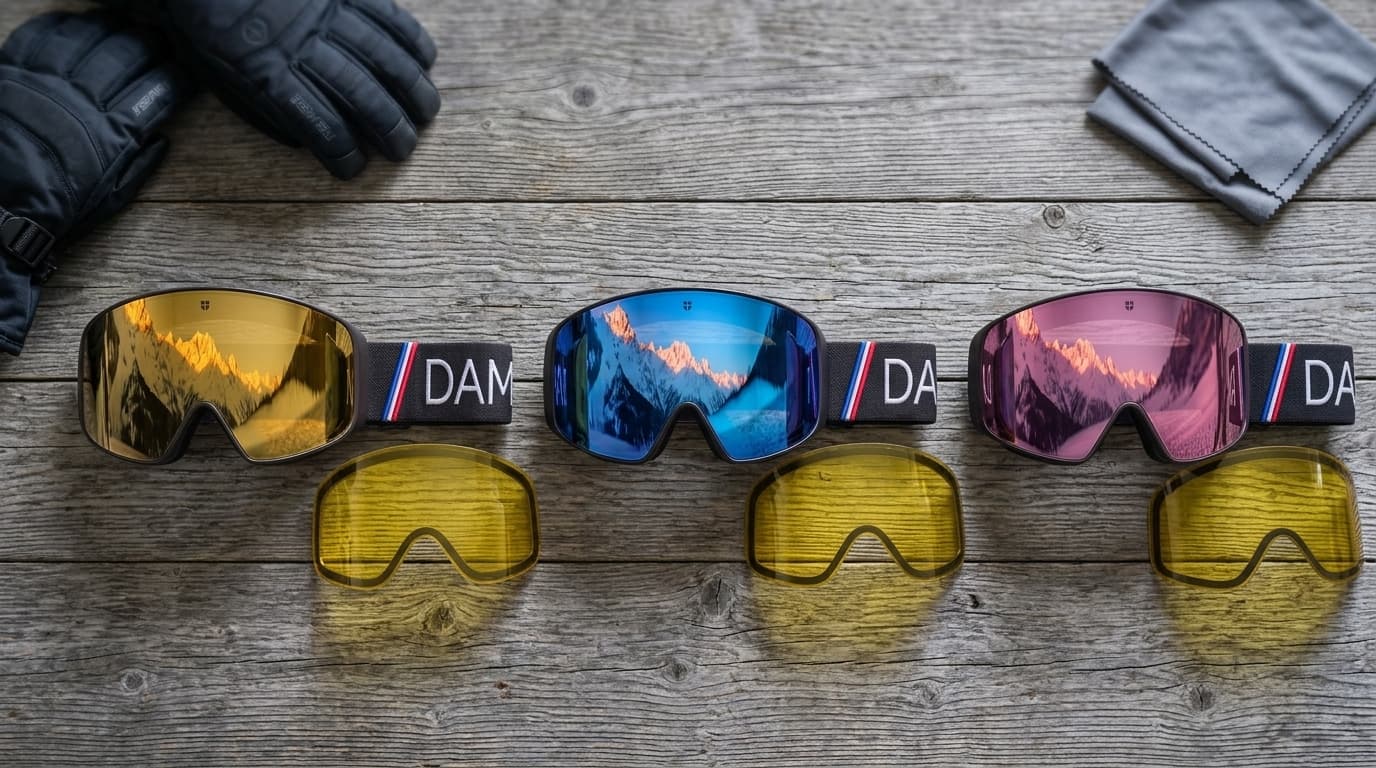
Lens category, shape, lens-change system, fit, anti-fog, helmet compatibility, budget: follow these seven steps to pick the right ski goggles — no hype, just practical buying advice.
**The short version:** Choosing ski goggles means making seven decisions in the right order: lens category, lens shape, lens-change system, fit, anti-fog, helmet compatibility, and budget. This guide walks you through each one, with no filler. DAMO appears as an example in several places, but the goal is to give you the framework to evaluate any pair of goggles.
1. Lens Category (S0–S4) — The First Decision
VLT (Visible Light Transmission) determines how much light reaches your eyes. Everything else comes after.
| Category | VLT Range | Typical Conditions |
|---|---|---|
| **S0** | 80–100 % | Night skiing, indoor |
| **S1** | 43–80 % | Overcast, heavy snow |
| **S2** | 18–43 % | Cloudy to variable, "all-rounder" |
| **S3** | 8–18 % | Full sun — the resort standard |
| **S4** | 3–8 % | Glacier, high alpine, extreme glare |
**For resort skiing**, S3 is the most common choice. Most skiers ride between 9 am and 4 pm under often-intense winter sun. It's also the category of all three DAMO lenses (Pink, Blue, Gold).
**The smart move: two lenses, not one.** An S3 lens for sunny days + an S1 lens for fog, snow, or late afternoon. That's exactly DAMO's approach: every goggle ships with an S3 tinted lens plus an S1 yellow fog lens.
2. Lens Shape — Cylindrical, Spherical, or Toric
Lens shape affects distortion, field of view, and price.
- **Cylindrical:** Curved horizontally, flat vertically. Cheaper, more edge distortion. Fine for a first pair or a tight budget.
- **Spherical:** Curved in both axes (like an eye). Better optical clarity, less distortion, more internal volume. The standard for mid-range and premium goggles.
- **Toric:** A spherical variant with different curvature radii on each axis. Fits the face more naturally, offers a wide field of view. Typically the most expensive.
If your budget allows, go spherical or toric. The clarity difference is noticeable over a full day on snow.
3. Lens Change System
Being able to swap lenses quickly as conditions change is a genuine advantage. Two main systems:
- **Clip-in / removable frame:** The lens clips into a frame that detaches from the goggle body. Reliable, proven, but takes two hands and some dexterity.
- **Magnetic:** The lens is held by magnets. Fastest swap — often one-handed. Check retention force: a weak magnet can release on impact. DAMO uses a magnetic system.
Both work well. Magnetic is more convenient day-to-day; clip-in is often more affordable.
4. Fit and Sizing
A goggle should hug your face without pressure points.
- **Foam quality:** Double or triple-layer foam (microfleece + foam + fleece) signals lasting comfort.
- **Nose bridge:** The goggle should cover your nose without pressing. If you feel pressure after 10 minutes, the model isn't for you.
- **Face seal:** No gap between forehead and goggle, or between cheek and foam. Test with your helmet on.
5. Anti-Fog — Don't Skip This
A fogging goggle is a blind goggle. Every decent pair uses a **dual-lens** construction with a sealed air gap between layers (same principle as double-pane windows). The inner lens gets a permanent hydrophilic coating that spreads condensation into a transparent film instead of light-scattering droplets.
**Key check:** Look for anti-fog tested to a standard (EN 166 or EN ISO 18527-1). If the manufacturer doesn't cite a standard, the "anti-fog" claim is unverified.
DAMO's approach: outer optical-grade polycarbonate lens + inner cellulose acetate lens with permanent silicone-based hydrophilic anti-fog coating, sealed inside the dual-layer structure. The coating is physically protected — it can't be wiped off or degraded by cleaning.
6. Helmet Compatibility
Nearly all modern goggles are helmet-compatible, but verify:
- **Strap length:** Must wrap around a standard helmet. Most straps run 45–50 cm.
- **Strap attachment:** Wide straps or clips that hook behind the helmet.
- **Goggle top edge:** Some models have a very straight top edge that can bump against a helmet visor.
Best test: bring your helmet to the shop and try them together.
7. Budget — What to Spend
Rough price bands:
- **Under €50:** Cylindrical lens, limited lens swapping, basic anti-fog. Fine for occasional use.
- **€50–100:** Quality spherical or cylindrical lens, swappable system, tested anti-fog. The sweet spot for most skiers. DAMO sits at ~€80 presale.
- **€100–200:** Toric lens, wide field of view, multi-layer coatings, magnetic system. Premium optics and comfort.
- **€200+:** Photochromic, HUD display, designer collaborations. You're paying for tech or brand.
**Our advice:** Don't cut corners on optics and anti-fog. A €30 goggle works once; over a season, investing in the €50–100 range pays off in comfort and visibility.
FAQ
**Q: Can I get by with one lens all season?** A: Yes — a versatile S3 covers most resort conditions. But adding an S1 or S2 lens transforms flat-light and late-afternoon skiing.
**Q: Are photochromic lenses worth it?** A: They auto-adjust tint — convenient but slower in cold temperatures and expensive. A two-lens system (S3 + S1) remains more performant and better value.
**Q: Do I need helmet-compatible goggles?** A: If you wear a helmet (and you should), yes. Non-compatible goggles leave a gap at the forehead or press uncomfortably.
**Q: Is magnetic lens-holding reliable?** A: On good models, yes. Check that the retention force is strong enough — the lens shouldn't shift when you shake the goggle.
**Q: Should I prioritise a spherical lens?** A: If your budget allows, yes. The reduction in distortion and wider field of view is noticeable, especially at speed.
Sources
- REI Co-op — "How to Choose Ski Goggles" (https://www.rei.com/learn/expert-advice/goggles.html)
- OutdoorGearLab — "Best Ski Goggles of 2026 Buying Guide" (https://www.outdoorgearlab.com/topics/snow-sports/best-ski-goggles)
- Alpenglow Adventure Sports — "Ski Goggle Technology Explained" (https://www.alpenglowgear.com/blogs/adventureawaits/ski-goggle-technology-explained-lens-types-anti-fo)
- EN ISO 18527-1:2022 — Filter categories and optical requirements (https://www.iso.org/standard/62788.html)
- ZIONOR — "Ski Goggle Buyer's Guide" (https://zionor.com/blogs/your-exercise-expert/ski-goggles-lens-color-analysis-what-color-is-right-for-what-weather)
**Related articles:** [Ultimate Guide to Ski Goggle Lens Technology](/en/blog/lens-technology-guide) · [DAMO vs Oakley: Lens Technology Compared](/en/blog/damo-vs-oakley) · [DAMO vs Smith: ChromaPop vs DAMO Optics](/en/blog/damo-vs-smith) · [DAMO vs Bollé](/en/blog/damo-vs-bolle) · [How to Care for Your Ski Goggles](/en/blog/ski-goggle-care)
The DAMO goggle — two lenses included, €80 on preorder
Sealed double anti-fog lens, magnetic interchangeable lens system, and a free yellow fog lens. Free shipping in France.
Visit the shopRelated articles
2026-08-28
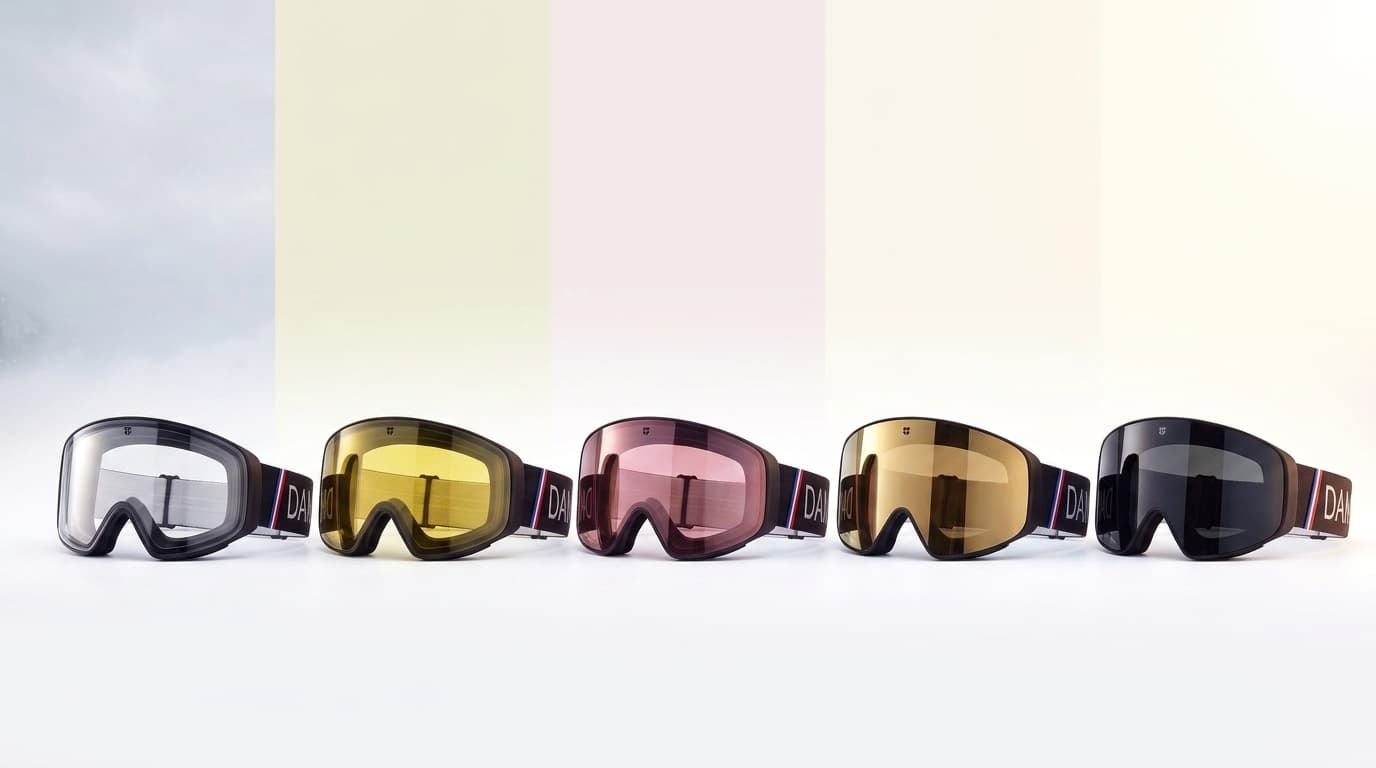
What Is VLT in Ski Goggles? Complete S0–S4 Guide
Everything you need to know about VLT (Visible Light Transmission) and S0–S4 filter categories for ski goggles: EN ISO 18527-1 standard, spectrophotometry, worked examples with DAMO lens values.
2026-08-28
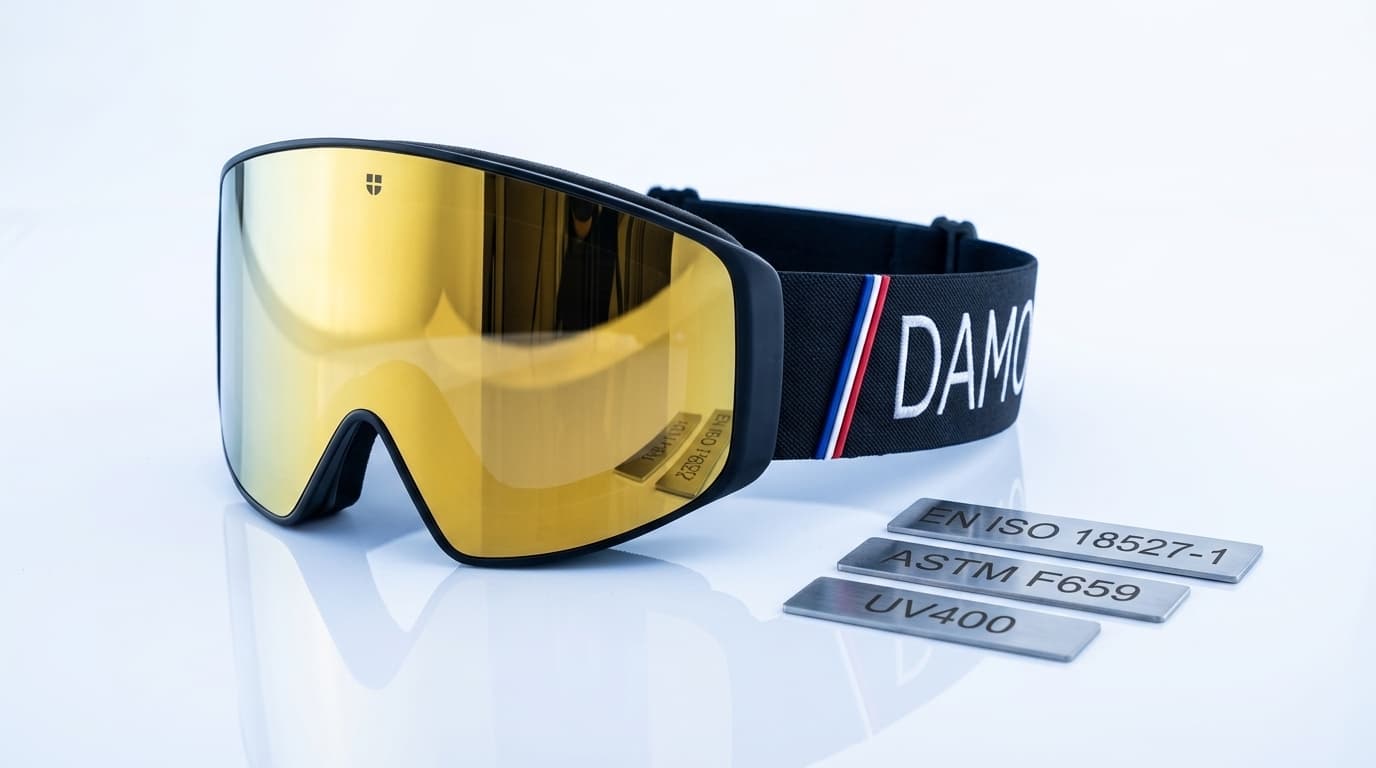
Ski Goggle Safety Standards: The Complete Guide
EN ISO 18527-1:2022, ASTM F659, UV400, CAT 1-4 filter categories: everything you need to know about the safety standards that regulate ski goggles in Europe and the US.