Lens Tech Face-Off: Prizm, ChromaPop, Perceive, VIVID, Clarity Compared
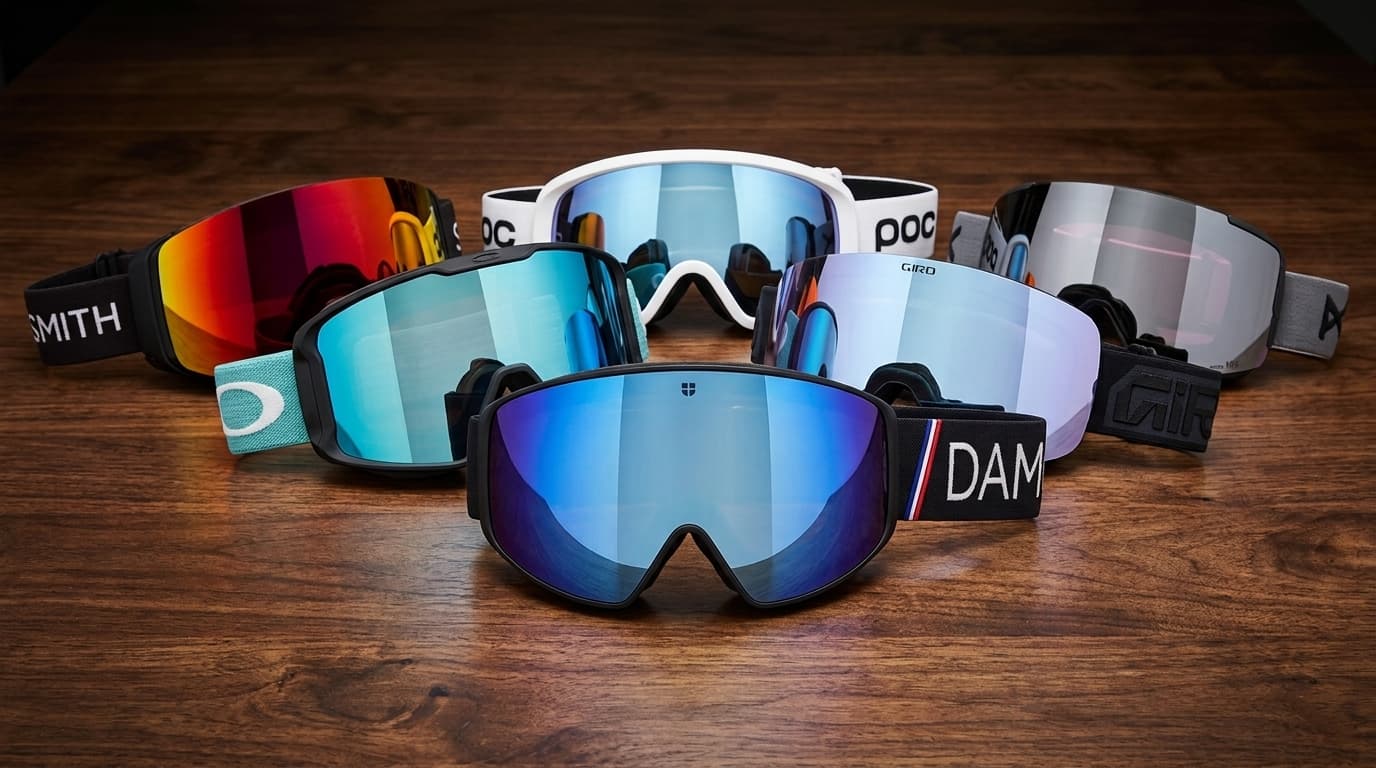
Technical comparison of ski goggle lens technologies: Prizm, ChromaPop, Perceive, VIVID, Clarity, and DAMO — optical principles, VLT ranges, materials — data as of 28 August 2026.
“**This comparison is published by DAMO Gears comparing various lens technologies available on the market.** All data is drawn from manufacturer-published specifications captured on 28 August 2026. No independent testing has been conducted by DAMO. All brand names and technologies are trademarks of their respective owners.”
— This comparison is published by DAMO Gears comparing various lens technologies available on the market.
**At a glance:** Five major lens technologies optimise contrast on snow — Prizm (Oakley), ChromaPop (Smith), Perceive (Anon), VIVID by Zeiss (Giro), and Clarity by POC (Zeiss). Each uses a different optical principle: proprietary dye tuning, spectral filtering, advanced photochromics, or multi-layer interference coatings. This article breaks down their approaches, VLT ranges, materials, and positioning. DAMO's optical approach is included for context. No rankings — a factual landscape view.




What This Article Is (and Is Not)
This technical overview describes the operating principles and published specifications of each lens technology as of 28 August 2026. It includes no field testing, independent lab measurements, or qualitative judgments. Missing data is marked as "Not published by manufacturer as of 28 August 2026."
Why So Many Lens Technologies?
Skiing and snowboarding happen in wildly variable light: from blinding high-altitude sun to dense forest fog. Each manufacturer has developed its own optical answer to improve contrast, terrain readability, and visual comfort. Five major approaches dominate the market, with DAMO's approach completing the picture.
1. Oakley Prizm™
**How it works:** Proprietary patented dye formula that tunes specific wavelengths of the light spectrum to boost contrast on snow. The base tint for most Prizm Snow lenses is garnet (rose).
- **Introduced:** 2015
- **Lens material:** Plutonite® (injection-molded polycarbonate)
- **VLT range (snow):** 5.5% (Black Iridium) to ~90% (Clear)
- **Photochromic:** No
- **Polarized:** Not offered for snow
- **Dual-layer:** Varies by model (Line Miner Pro: single-layer)
**Selected Prizm Snow VLT values:**
| Lens | VLT | Category |
|---|---|---|
| Black Iridium | 5.5% | S4 |
| Dark Grey | 11% | S3 |
| Sapphire Iridium | 13% | S3 |
| Torch Iridium | 17% | S3 |
| Hi Pink | ~40% (est.) | S2 |
| Clear | ~90% | S0 |
*source: SportRx, "Prizm Snow Lens Guide," Aug 2024 — https://www.sportrx.com/blog/oakley-prizm-snow-lens-guide/ (retrieved 28 August 2026)*
2. Smith ChromaPop™
**How it works:** Filters the spectral crossover zone where blue and green overlap — the region where the human eye struggles most to distinguish nuances. By removing this colour confusion, ChromaPop lets the eye see more natural colours with enhanced definition.
- **Introduced:** ~2014 (consumer launch)
- **Lens material:** Polycarbonate (outsourced manufacturing)
- **VLT range:** 9% (Sun Green Mirror) to 65% (Storm Yellow Flash)
- **Photochromic:** Yes (ChromaPop Pro: Rose Flash 20–40%, Red Sensor 30–50%)
- **Polarized:** Yes (select Sun lenses)
**Selected ChromaPop VLT values:**
| Lens | VLT | Category |
|---|---|---|
| Sun Green Mirror | 9% | S3 |
| Sun Black | 12% | S3 |
| Sun Red Mirror | 16% | S3 |
| Everyday Rose Gold | 23% | S2 |
| Storm Yellow Flash | 65% | S1 |
*source: SportRx, "ChromaPop Lens Guide," Oct 2022 — https://www.sportrx.com/blog/smith-chromapop-goggle-lens-guide/ (retrieved 28 August 2026)*
Smith is the only manufacturer on this list offering a wide-range photochromic option (20–50%) within its contrast-enhancing lens family.
3. Anon Perceive™
**How it works:** Developed exclusively for snow sports, Perceive increases depth perception and enhances contrast while maintaining "true colours" — less colour shift than some competing technologies, according to Anon.
- **Lens material:** Polycarbonate + cellulose acetate (dual-layer)
- **VLT range:** 6% (Sunny Onyx) to 72% (Cloudy Night)
- **Photochromic:** No
- **Polarized:** Yes (Perceive Polarized range, launched 2024/25)
- **Anti-fog:** ICT (hydrophilic embedded in cellulose)
**Selected Perceive VLT values:**
| Lens | VLT | Category |
|---|---|---|
| Sunny Onyx | 6% | S4 |
| Sunny Red | 14% | S3 |
| Sunny Bronze | 17% | S3 |
| Variable Violet | 34% | S2 |
| Cloudy Pink | 53% | S1 |
| Cloudy Night | 72% | S1 |
*source: SportRx, "Anon Lens Guide," Jan 2024 (retrieved 28 August 2026)*
Perceive distinguishes itself with a polarized option in the snow goggle category — still relatively rare across the industry.
4. Giro VIVID by Zeiss
**How it works:** Developed in partnership with Zeiss Optics (a global leader in precision optics). VIVID selectively filters blue light (the wavelength responsible for atmospheric haze) while boosting contrast-enhancing wavelengths.
- **Lens material:** Polycarbonate (Zeiss optics)
- **VLT range:** 3% (Jet Black) to 90% (Clear/Apex)
- **Photochromic:** No
- **Polarized:** No
- **Coatings:** Anti-fog and scratch-resistant (standard)
**Selected VIVID VLT values:**
| Lens | VLT range | Category |
|---|---|---|
| VIVID Jet Black | 3–7% | S4 |
| VIVID Onyx | 8–18% | S3 |
| VIVID Ember | 19–42% | S2 |
| VIVID Infrared | 43–79% | S1 |
| VIVID Apex | 80–90% | S0 |
*source: Giro.com, "What Does VLT Mean?" — https://www.giro.com (retrieved 28 August 2026)*
VIVID's Zeiss partnership brings optical credibility from the photography and industrial worlds. Giro claims natural colour rendering without over-saturation.
5. POC Clarity by POC™
**How it works:** Developed in partnership with Carl Zeiss (lens supplier). Clarity filters specific colour-spectrum peaks to sharpen the visual experience in specific environments. Four intensity tiers: Universal, Intense, Highly Intense, and POCito (youth).
- **Lens material:** Polycarbonate (by Zeiss) + Ri-Pel™ treatment (hydrophobic/oleophobic)
- **VLT range:** 10% (Sunny Silver, Highly Intense) to 58% (Low Light Orange)
- **Photochromic:** Yes (Clarity Comp, CAT 1–3, select models)
- **Polarized:** No
**Selected Clarity VLT values:**
| Lens | VLT | Intensity |
|---|---|---|
| Sunny Silver | 10% (S3) | Highly Intense |
| Sunny Gold | 13% (S3) | Intense |
| Partly Sunny Blue | 22% (S2) | Highly Intense |
| Partly Sunny Orange | 32% (S2) | Intense |
| Low Light Orange | 58% (S1) | — |
*source: The Race Place, "POC Goggle Lens Guide" (retrieved 28 August 2026); POC.com — https://www.poc.com (retrieved 28 August 2026)*
Clarity is the only technology in this lineup offering graded contrast intensity levels (Universal → Highly Intense) rather than a simple VLT gradient. POC also applies Ri-Pel™ treatment that repels water and fingerprints.
6. DAMO's Approach
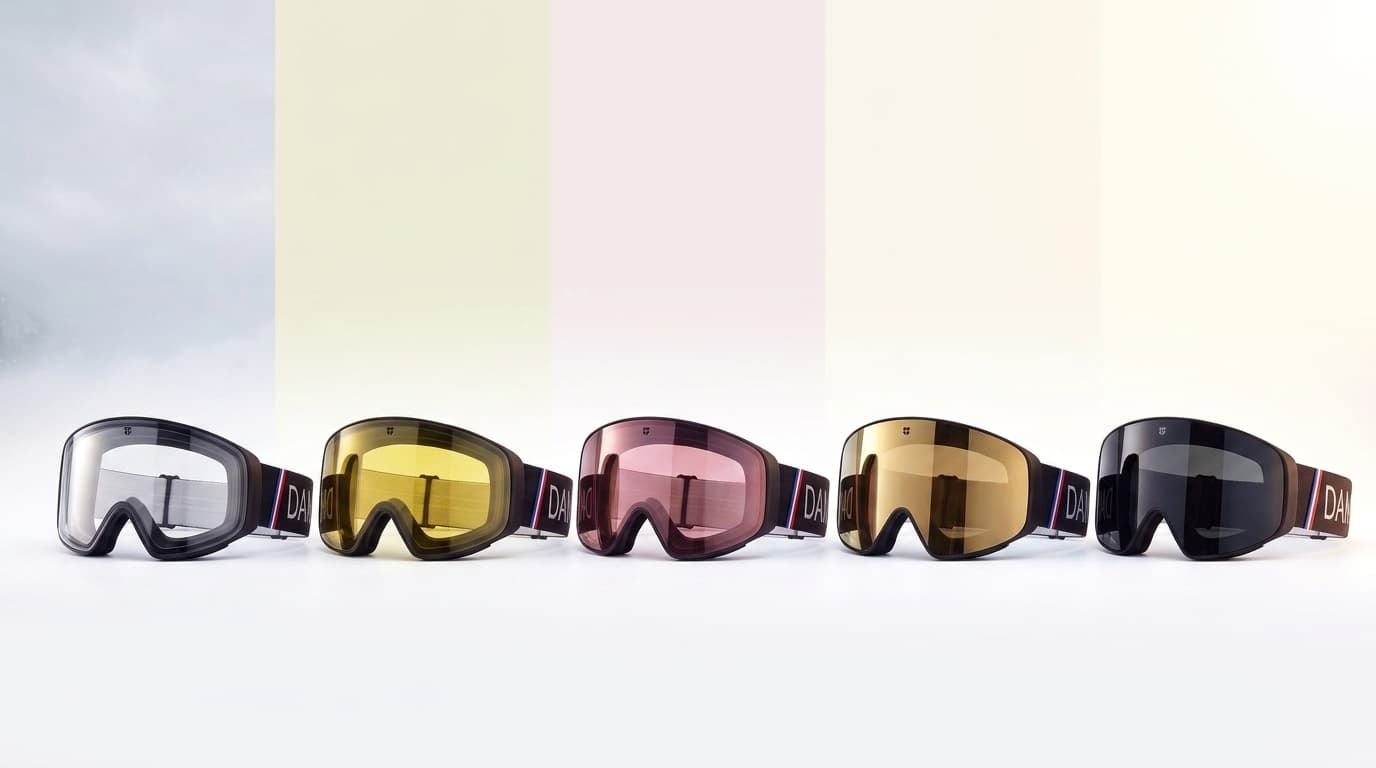
DAMO uses a combination of tint and multi-layer interference mirror coating (SiO₂/Ti₃O₅) on an optical polycarbonate outer lens, paired with a cellulose acetate inner lens with permanent hydrophilic anti-fog treatment.
**DAMO optical data (supplier measurements):**
| Variant | Measured VLT | Category | Uniformity |
|---|---|---|---|
| Pink | ~17.00% | S3 | 3.41% ✅ |
| Dream Blue | ~12.06% | S3 | 0.08% ✅ |
| Gold | ~13.95% | S3 | 1.92% ✅ |
| Yellow fog lens | ~74–75% | S1 | — |
- **Photochromic:** No (fixed tint)
- **Polarized:** Supplier option, not confirmed in production
- **Dual-layer:** Yes (PC + cellulose acetate, sealed air gap)
- **UV protection:** UV400 (measured 0.00% UV-B/UV-A)
**Note:** Current optical measurements are supplier technical data referencing ISO/DIS 18527-1:2022.
Cross-Comparison
| Technology | Brand | Optical principle | Photochromic? | Polarized? | Optics partner |
|---|---|---|---|---|---|
| Prizm™ | Oakley | Proprietary spectral dye tuning | No | No | In-house (Luxottica) |
| ChromaPop™ | Smith | Blue-green crossover filter | Yes (Pro) | Yes (select) | In-house |
| Perceive™ | Anon | Contrast + depth perception | No | Yes (Pol range) | In-house |
| VIVID | Giro | Blue filtering + contrast boost | No | No | Zeiss Optics |
| Clarity™ | POC | Spectral filtering by intensity | Yes (Comp) | No | Carl Zeiss |
| DAMO | DAMO | Tint + multi-layer interference | No | Option (unconfirmed) | Supplier |
The value-for-money verdict
The sections above describe each technology without ranking them — deliberately: no independent test proves one approach optically superior to another. This section is our reading of the facts, and it is only fair to state once more that it is published by DAMO.
Prizm, ChromaPop, Perceive, VIVID and Clarity are genuine optical innovations, backed by years of R&D. But they share one trait: they ride in goggles priced at $125–400, and the second lens — essential as soon as the weather turns — is often sold separately. For most recreational skiers, the perceptible contrast gap between these proprietary formulations and a well-executed tint + interference mirror combination is real but marginal — certainly smaller than the price gap.
DAMO makes the opposite bet: invest in the fundamentals all these technologies share — sealed dual-layer construction, a permanent anti-fog coating protected between the layers, UV400 protection measured at 0.00% — and ship two dedicated lenses (S3 sun + S1 fog) for €80–100. No trademarked proprietary formula, but measured and published specifications.
If you ski forty days a season in highly variable conditions and you can perceive the colour-rendering difference of a ChromaPop or a Prizm, those technologies earn their premium. For everyone else — skiers who want clear, fog-free vision from first lift to last, without paying the brand markup — technology per euro favours DAMO. That is the bet this brand was founded on.
FAQ
**1. Which lens technology is the most popular?** Oakley Prizm and Smith ChromaPop are the two most referenced technologies by reviewers and consumers. Switchback Travel (2026) calls ChromaPop "the best for richness of color and contrast" and places Prizm "neck-and-neck." Anon Perceive and Giro VIVID are also well-regarded. No single technology is universally preferred — choice depends on individual visual preference.
**2. Can I use a Prizm lens on a Smith goggle frame?** No. Each technology is tied to its brand's frame system. Lenses are not interchangeable across brands.
**3. Is photochromic a deciding factor?** It depends on your use case. If you ski in highly variable conditions (sun, cloud, trees) and don't want to swap lenses, a photochromic option like ChromaPop Pro (20–50%) or Clarity Comp may suit you. For predominantly sunny conditions, a quality fixed S3 lens typically delivers superior contrast.
**4. What's the difference between a mirror coating and a tint?** A mirror (interference) coating reflects a portion of light before it reaches the tint, allowing lower VLT without excessively darkening the lens. The tint absorbs specific wavelengths. DAMO lenses combine both: a base tint (pink, blue, or gold) and a multi-layer mirror coating.
**5. Does DAMO plan to release photochromic lenses?** DAMO has not announced photochromic lenses. The three launch S3 lenses are fixed-tint, with a separate S1 yellow lens for low light. Future lens portfolio expansion will be communicated at a later date.
Sources
- SportRx, "Oakley PRIZM Snow Lenses: The Complete Lens Guide," 29 Aug 2024 — https://www.sportrx.com/blog/oakley-prizm-snow-lens-guide/ (retrieved 28 August 2026)
- SportRx, "SMITH ChromaPop Goggle Lens Guide," 26 Oct 2022 — https://www.sportrx.com/blog/smith-chromapop-goggle-lens-guide/ (retrieved 28 August 2026)
- SportRx, "Anon Lens Guide," 18 Jan 2024 (retrieved 28 August 2026)
- Next Adventure, "Smith Goggle Lens Tint Guide" (retrieved 28 August 2026)
- Giro.com, "What Does VLT Mean?" — https://www.giro.com (retrieved 28 August 2026)
- The Race Place, "POC Goggle Lens Guide" (retrieved 28 August 2026)
- POC.com, "Clarity by POC — The Colours of Snow" — https://www.poc.com (retrieved 28 August 2026)
- Boardsport SOURCE, 2024/25 Previews (Oakley, Smith, Anon, Giro) (retrieved 28 August 2026)
- BetterTrail, "Smith Ski Goggles: A Complete Guide," Oct 2025 (retrieved 28 August 2026)
- Christy Sports, "Giro VIVID Goggles for Flat Light," Jan 2026 (retrieved 28 August 2026)
- Switchback Travel, "Best Ski Goggles of 2026" (retrieved 28 August 2026)
- The Original — Product specification and BOM (supplier/internal)
- Supplier optical reports: Pink.pdf, Dream blue.pdf, gold.pdf (supplier/internal)
- DAMO Gears, 14-product-spec-lenses.md (internal)
*Last updated: 28 August 2026. Specifications may have changed since. All brand names and technologies are trademarks of their respective owners. Published by DAMO Gears.*
The DAMO goggle — two lenses included, €80 on preorder
Sealed double anti-fog lens, magnetic interchangeable lens system, and a free yellow fog lens. Free shipping in France.
Visit the shopRelated articles
2026-08-28
What Is VLT in Ski Goggles? Complete S0–S4 Guide
Everything you need to know about VLT (Visible Light Transmission) and S0–S4 filter categories for ski goggles: EN ISO 18527-1 standard, spectrophotometry, worked examples with DAMO lens values.
2026-08-28
UV Protection in Ski Goggles: The Complete Guide
Complete guide to UV protection in ski goggles: UV400, ISO 18527-1 standards, altitude effects, myths debunked, and what to look for when buying.