Lens Testing at DAMO — Our Quality Process in the Open
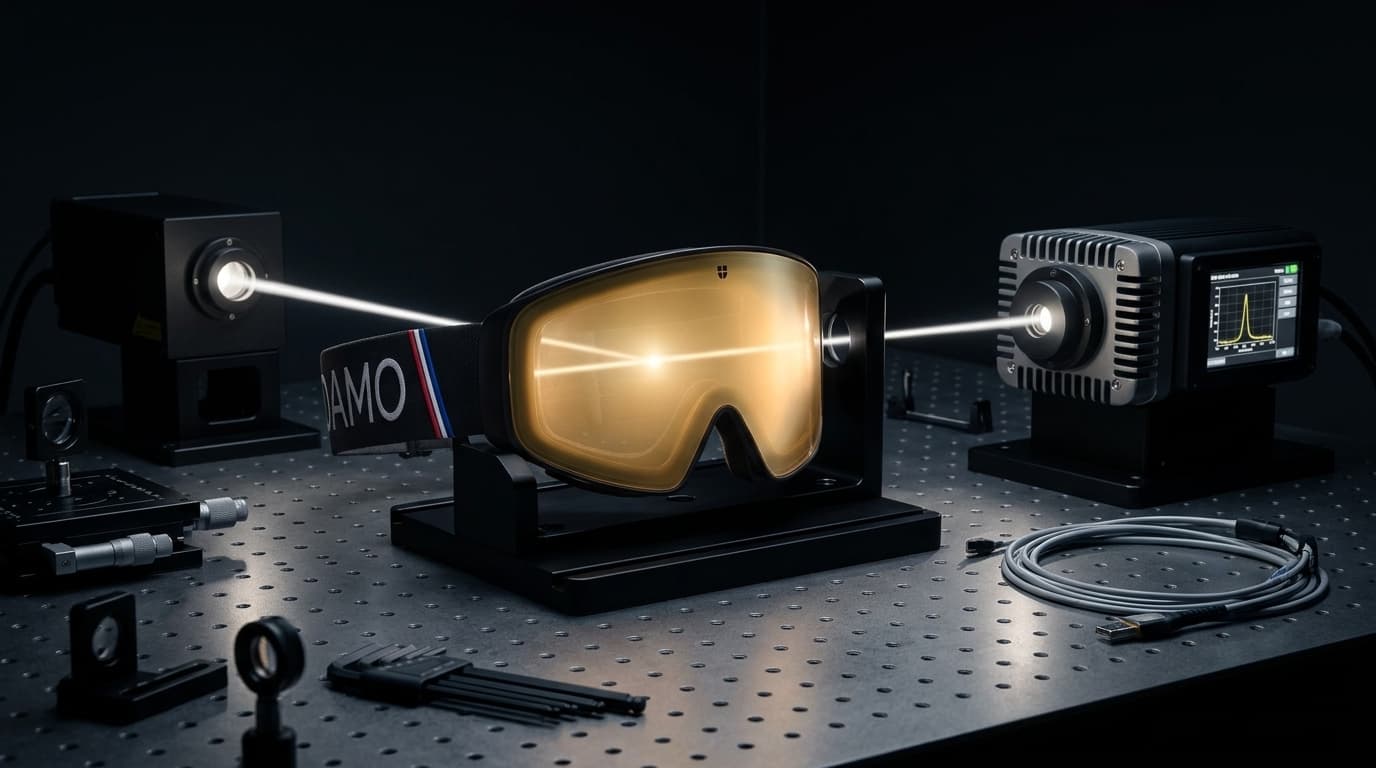
See the lens testing results behind DAMO goggles: VLT/S3 category, UV protection, optical quality, anti-fog, field of view — and what each number means for you on the slopes.
“**The bottom line:** DAMO's lens quality data comes from two sources: (1) independent testing by Intertek Testing Services on The Original (EN ISO 18527-1:2022), and (2) supplier optical reports for the specific DAMO launch colours (ISO/DIS 18527-1:2022). Here's what each test means in plain language — with all the caveats included.”
— The bottom line:
Why Publish Test Results?
Trust isn't declared — it's demonstrated. We're publishing numbers from independent lab testing and supplier data.
We're publishing these results **as-is** — caveats and all. This isn't a marketing campaign. It's a snapshot of where we are in product development, shared openly.
Two Testing Streams
A quick distinction before we get into the numbers:
**Supplier optical reports** (Pink.pdf, Dream blue.pdf, gold.pdf) — the supplier measured the specific DAMO launch lens colours (Pink ~17%, Blue ~12%, Gold ~14%). These reference **ISO/DIS 18527-1:2022**. The values meet the requirements of the published standard.
**Intertek testing (SHAH01697484)** — The Original was tested by Intertek Testing Services against the final **EN ISO 18527-1:2022** standard. The tested sample carried S2 tint category (~25% VLT), not DAMO's S3 launch specification. The results — spherical power, prism, scattered light, anti-fog, field of view — demonstrate the goggle's optical quality. The Original uses a PC + cellulose acetate optical architecture.
The Lab: Intertek Wenzhou
Intertek tested The Original at **Intertek Testing Services Ltd., Zhejiang, Wenzhou Branch** — a laboratory accredited by **CNAS** (China National Accreditation Service) and **IAS** (International Accreditation Service).
Test Results, Explained
Visible Light Transmission (VLT) and S3 Category
**What's measured:** VLT is the percentage of visible light that passes through the lens to your eye. Measured by spectrophotometer using D65 standard daylight illuminant.
**Our results (from supplier optical reports, ISO/DIS 18527-1:2022):**
All three DAMO variants fall in the S3 category (8–18%):
- Pink: ~17.00% — suitable for sunny to partly cloudy days
- Blue: ~12.06% — suited for bright sun
- Gold: ~13.95% — a brightness/contrast balance
**Why it matters:** S3 is the most common category for resort skiing. It offers enough protection for bluebird days while remaining usable when the sun ducks behind a cloud.
**Note:** These values come from supplier testing per ISO/DIS 18527-1:2022. The test methods align with EN ISO 18527-1.
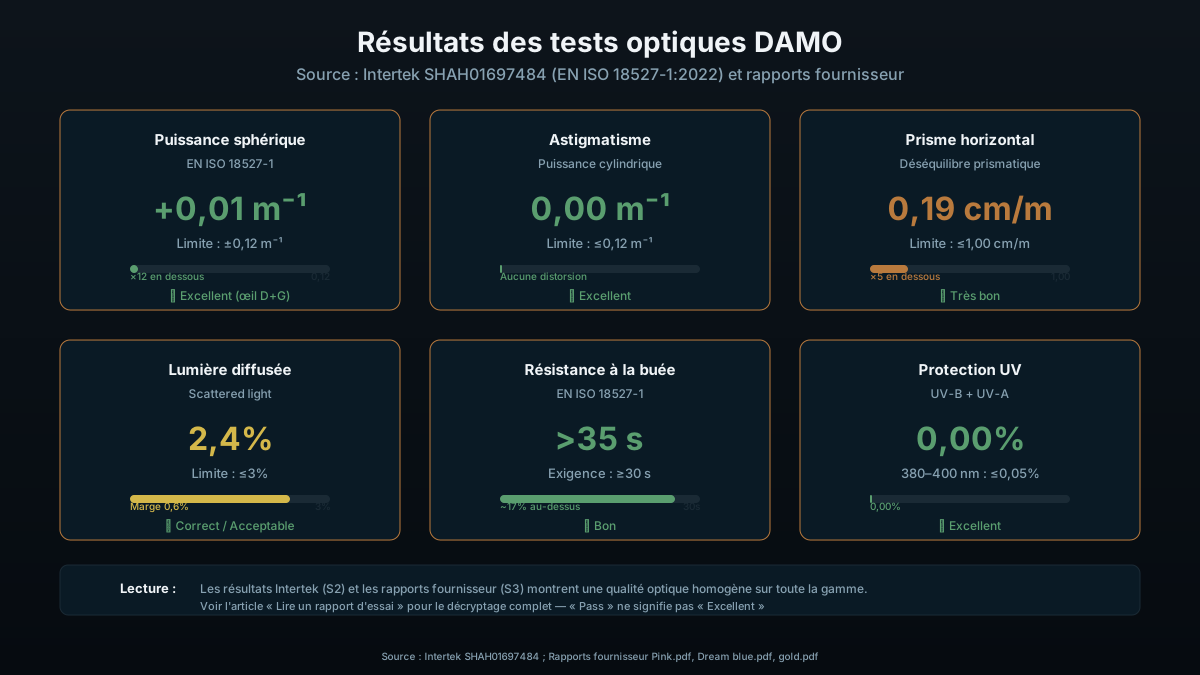
UV Protection — 0.00% UV-B and UV-A
**What's measured:** The spectrophotometer scans from 280 to 400 nm to measure UV transmission.
**Our results (Intertek, final standard + supplier optical reports):**
The Intertek test recorded 0.00% UV-B and UV-A transmission. Supplier reports for Pink, Blue, and Gold show the same result: 0.00% for UV-B (280–315 nm) and UV-A (315–380 nm), with mean 380–400 nm ≤ 0.05%.
**Why it matters:** At 2,000 m elevation, UV radiation is 30–50% higher than at sea level. Fresh snow reflects up to 80% of UV rays. Reliable UV protection at altitude isn't optional.
Optical Quality: Spherical Power +0.01 (Intertek Test)
**What's measured:** A ski goggle lens should be plano (zero corrective power). EN ISO 18527-1 allows a maximum of ±0.12 m⁻¹ spherical power.
**Intertek result:** +0.01 m⁻¹ in both eyes — well below the limit. Astigmatism (cylindrical power) is 0.00 m⁻¹.
**Why it matters:** The closer to zero, the less your eyes have to compensate. A lens near the ±0.12 limit can cause noticeable eye strain.
**Note:** This test was performed on The Original (S2 category). The same PC+CA optical architecture is used across the range.
Prism Balance: 0.19 cm/m (Intertek Test)
**What's measured:** Prism measures image displacement between the two eyes. Excessive misalignment forces your brain to fuse two offset images.
**Intertek result:** 0.19 cm/m horizontal (base out) — the standard allows up to 1.00 cm/m.
**Why it matters:** Well-balanced prism means both eyes work in sync. That's critical for depth perception and reading terrain changes.
Scattered Light: 2.4% (Intertek Test)
**What's measured:** The fraction of light randomly dispersed as it passes through the lens instead of travelling straight.
**Intertek result:** 2.4% — the standard requires ≤ 3%.
**Why it matters:** Excessive scattered light reduces image contrast. In flat light or fog, this can mean the difference between spotting a rollover and catching it unexpectedly.
Anti-Fog: >35 Seconds (Intertek Test)
**What's measured:** The lens is exposed to warm humid air in a climate chamber. EN ISO 18527-1 requires a minimum of 30 seconds before condensation appears.
**Intertek result:** >35 seconds in both eyes — above the threshold.
**Why it matters:** The lab test is a single cold-to-warm transition. Real-world anti-fog must survive repeated exertion cycles, sweat, and temperature swings. 35 seconds in a lab is a solid baseline, but it's not a guarantee of infinite on-slope performance.
Field of View: >35° (Intertek Test)
**What's measured:** The angular area a skier can see without turning their head.
**Intertek result:** >35° in inferior and superior directions; >35° nasal; >65° temporal. All above requirements.
**Why it matters:** Adequate field of view is crucial for safety — seeing your ski tips in a turn, spotting snow changes, catching obstacles in peripheral vision.
The Caveat About Standard References
Each testing stream has a different standard reference:
- **Intertek:** Tested against the final **EN ISO 18527-1:2022** — PASS on all applicable requirements.
- **Supplier reports (Pink/Blue/Gold):** Reference **ISO/DIS 18527-1:2022**.
**What this means:**
- All measured values are reliable technical data
- The supplier reports document the production lens specifications
- The reports reference ISO/DIS 18527-1:2022, which aligns with the final EN ISO 18527-1 requirements
What Lab Tests Don't Cover
Thorough as these tests are, they have limits:
- **Anti-fog durability across a whole season:** the lab test is a single cycle. Real wear depends on seal integrity, thermal cycling, and humidity
- **Mirror coating resilience after 100+ cleanings:** abrasion testing (clause 14.3) is optional and not claimed — we don't have data on this yet
- **Colour rendering under real mountain light:** VLT uses standard D65 illuminant — mountain light varies with elevation, cloud cover, and time of day
- **Helmet compatibility and feel:** fit depends on individual face shape and helmet model
- **Subjective contrast preference:** very real, very personal — entirely outside standardisation
FAQ
Are the tests performed on final production units?
Yes — the Intertek tests were performed on The Original production units (S2 category, five pairs). The supplier optical reports were performed on The Original lens samples. These are final production specifications.
Can I see the full test reports?
We're publishing aggregated data here. The detailed Intertek report (SHAH01697484) and supplier optical reports are available on request.
Is DAMO CE certified?
CE certification for PPE Category II requires a complete technical file including assembled-product testing. That process is underway. The Intertek test results and supplier reports are steps toward that certification, not the certification itself.
Sources
- Intertek SHAH01697484 — Test Report (12 Jun 2024, EN ISO 18527-1:2022, S2 category)
- Pink.pdf — Supplier optical report (Pink, ISO/DIS 18527-1:2022)
- Dream blue.pdf — Supplier optical report (Blue, ISO/DIS 18527-1:2022)
- gold.pdf — Supplier optical report (Gold, ISO/DIS 18527-1:2022)
- EN ISO 18527-1:2022 — Eye and face protection for sports use
- ISO 18526-1/2/3:2020 — Test methods for optical properties
- [DAMO INTERNAL DOC] — 14-product-spec-lenses.md §5 (supplier optical results table)
- [DAMO INTERNAL DOC] — The Original Ski Goggles Specification & BOM summary
The DAMO goggle — two lenses included, €80 on preorder
Sealed double anti-fog lens, magnetic interchangeable lens system, and a free yellow fog lens. Free shipping in France.
Visit the shopRelated articles
2026-08-28
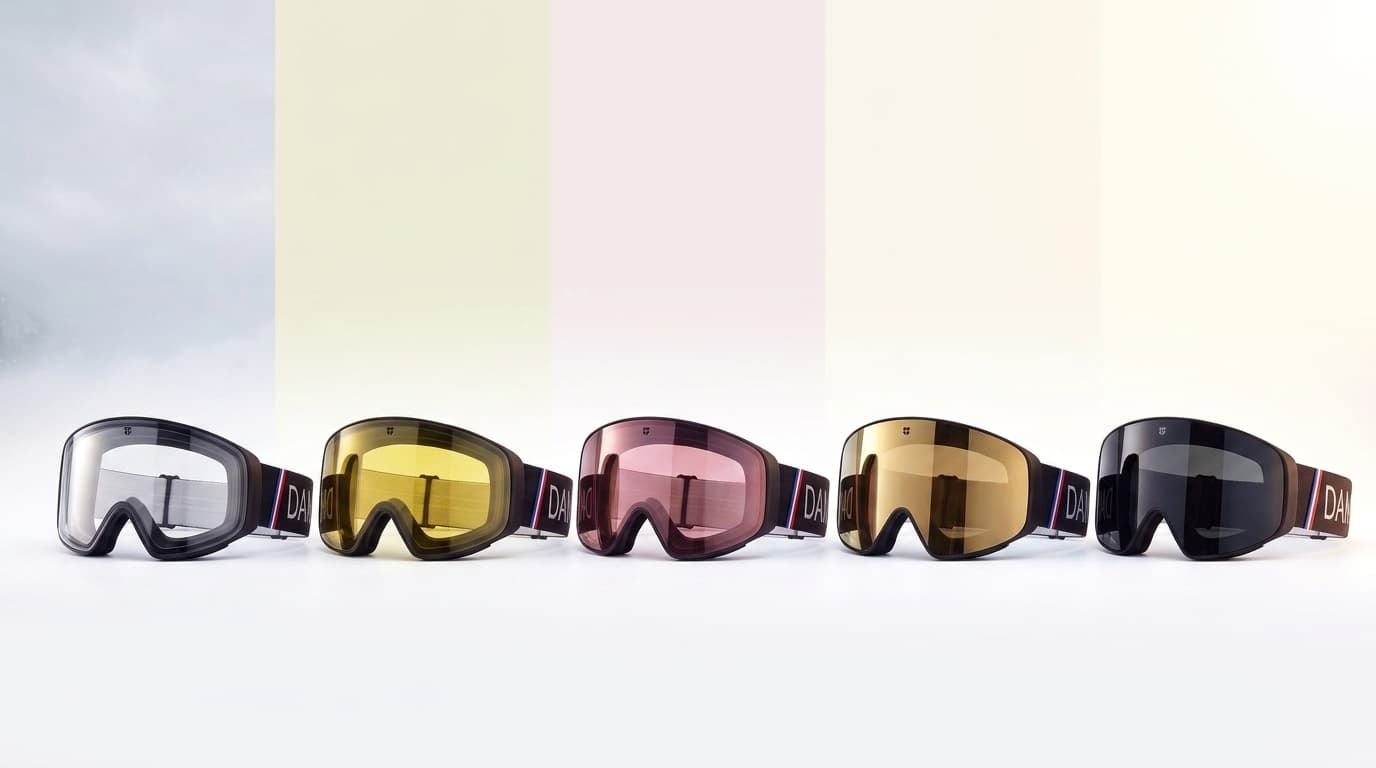
What Is VLT in Ski Goggles? Complete S0–S4 Guide
Everything you need to know about VLT (Visible Light Transmission) and S0–S4 filter categories for ski goggles: EN ISO 18527-1 standard, spectrophotometry, worked examples with DAMO lens values.
2026-08-28
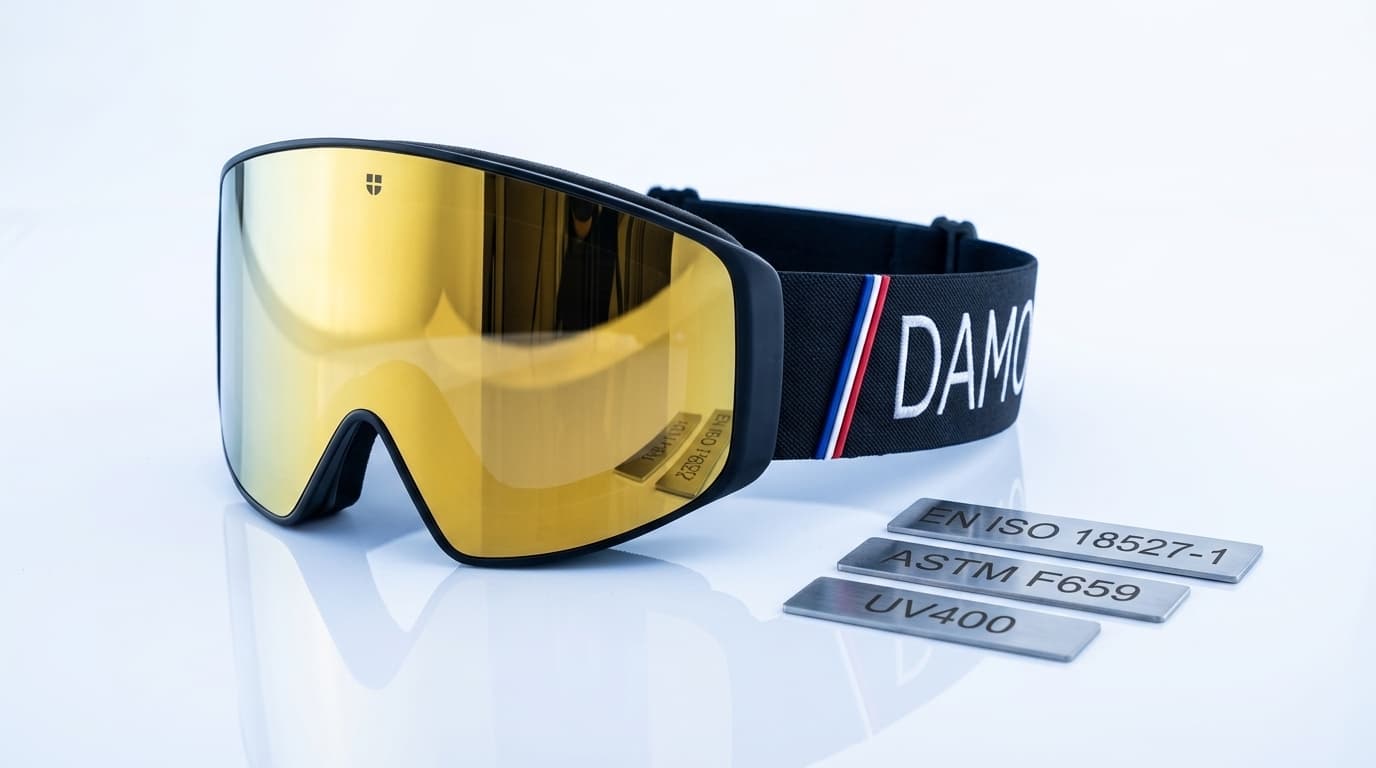
Ski Goggle Safety Standards: The Complete Guide
EN ISO 18527-1:2022, ASTM F659, UV400, CAT 1-4 filter categories: everything you need to know about the safety standards that regulate ski goggles in Europe and the US.