DAMO Goggle Materials — What We Know and What We Don't
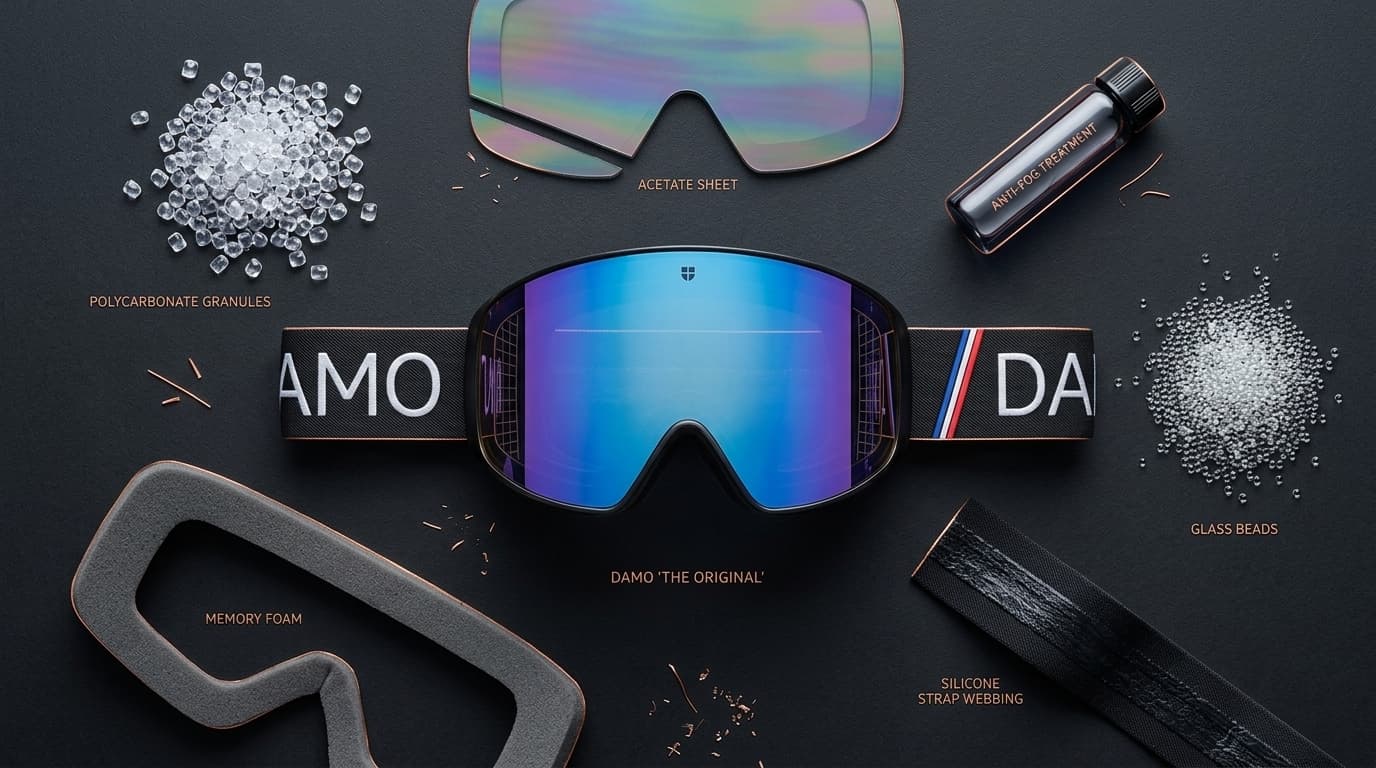
A transparent look at the materials used in DAMO goggles: outer lens, inner lens, frame, foam, strap, coatings — based on supplier documentation.
“**The bottom line:** We're laying out exactly what goes into The Original goggle based on supplier component documents. For every component we name the material, its documented composition. This article documents the production material specifications based on verified supplier data.”
— The bottom line:
Our Approach
This article documents each component according to the supplier's written specifications, covering every part of The Original goggle.
This article documents each component according to the supplier's written specifications. Where there's ambiguity, we flag it. This isn't green marketing — it's a transparency exercise.
Lens Composition
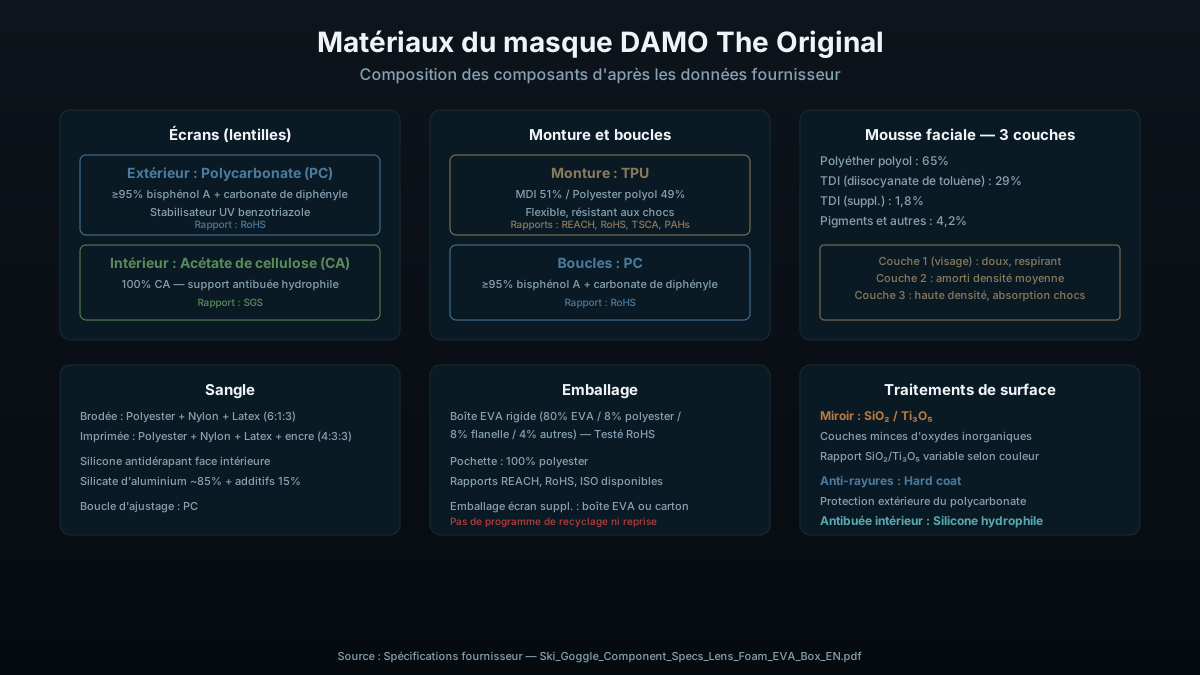
Outer Lens: Polycarbonate (PC)
The outer lens is **optical-grade polycarbonate**, a thermoplastic polymer widely used in sports eyewear for its impact resistance.
- **Composition:** polymer of diphenyl carbonate and bisphenol A
- **Concentration:** ≥ 95% – ≤ 100% (supplier RoHS declaration)
- **UV additive:** benzotriazole stabiliser (chloro-benzotriazole derivative) for UV400 protection
- **Supplier report:** RoHS
Polycarbonate is widely used in sports eyewear for its impact resistance — it does not shatter into sharp fragments on impact.
Inner Lens: Cellulose Acetate (CA)
The inner lens is **100% cellulose acetate**, a semi-synthetic polymer derived from natural cellulose.
- **Composition:** 100% cellulose acetate (supplier SGS declaration)
- **Role:** carrier for the permanent hydrophilic anti-fog coating
- **Supplier report:** SGS
Cellulose acetate is widely used in prescription eyeglass frames and optical applications. We do not make claims about its environmental fate — see our environmental position below.
Frame and Buckles
Main Frame: TPU (Thermoplastic Polyurethane)
The black frame is **TPU**, not polycarbonate. This is confirmed by the supplier's component composition table:
| Item | Material | Chemical composition | Ratio | Supplier report |
|---|---|---|---|---|
| Frame | TPU | MDI + polyester polyol | MDI 51% / polyester polyol 49% | REACH, RoHS, TSCA, PAHs, Halogen, Phthalates |
TPU is a flexible, impact-resistant material commonly used in goggle frames.
Side Buckle: PC (Polycarbonate)
The side buckle (frame-side strap interface) is **PC** (polymer of diphenyl carbonate and bisphenol A, ≥ 95% – ≤ 100%). Supplier report: RoHS.
Face Foam
The face-contact foam is specified as a **three-layer polyether foam**:
| Layer | Position | Function |
|---|---|---|
| Layer 1 | Outer (face contact) | Soft, breathable, skin-friendly material |
| Layer 2 | Middle | Medium-density foam for cushioning |
| Layer 3 | Inner (liner) | High-density foam for structure and impact absorption |
**Chemical composition (supplier data):**
- Propylene oxide & ethylene oxide polymer (polyether polyol): 65%
- Toluene diisocyanate (TDI): 29%
- Toluene diisocyanate (TDI): 1.8%
- Pigments & others: 4.2%
**Note:** The foam is wrapped with a skin-friendly fabric layer. Supplier test report: SGS.
This is not a standard polyurethane (PU) foam — it's polyether-based, with TDI as a major constituent.
Strap
The supplier's documentation provides two strap constructions:
| Option | Composition | Ratio |
|---|---|---|
| **Embroidered** | Polyester + Nylon + Latex | 6 : 1 : 3 |
| **Printed** | Polyester + Nylon + Latex + water-based ink | 4 : 3 : 3 (ink ratio unquantifiable) |
- **Additional material:** Anti-slip silicone on the inner face (aluminum silicate ~85%, disilane, olefin silicone ester, silicone amine, additives 15%)
- **Buckle (adjuster):** PC (same composition as side buckle)
- **Supplier reports:** SGS (strap), ECO (anti-slip silicone), RoHS (buckle)
Surface Treatments
Mirror Coating: SiO₂ / Ti₃O₅
The iridescent colour comes from a **thin-film stack of inorganic oxides**: SiO₂ (silicon dioxide) and Ti₃O₅ (trititanium pentoxide), applied by physical deposition. The SiO₂-to-Ti₃O₅ ratio varies by colour.
Anti-Scratch Hard Coat
A protective hard coat is applied to the outer surface.
Inner Anti-Fog Coating
The anti-fog coating is **silicone-based, hydrophilic**. Per the supplier composition:
| Component | Details |
|---|---|
| Base | Silicone series |
| Active compounds | Silicone, isopropanol, hydrophobic agent |
| Vehicle | Purified water (~50%) |
The presence of isopropanol (a solvent) means this coating formulation is not fully water-based.
Packaging
The packaging is **confirmed** per the supplier component spec:
- **Rigid EVA (ethylene-vinyl acetate) box** (H-type, crush-resistant): EVA 80%, polyester 8%, flannelette 8%, others 4%. RoHS tested.
- **Pouch bag:** 100% polyester. REACH, RoHS, ISO reports available.
- **Extra lens packaging:** small EVA box or paper box.
The EVA box is customisable with printed or embossed DAMO logo.
Our environmental position
We are clear about what we do not claim:
- **Biodegradability, recyclability, recycled content:** we have not tested, commissioned, or verified any end-of-life claims. Cellulose acetate and polycarbonate are theoretically recyclable through specialised channels, but we have no recycling programme or take-back scheme in place. We do not claim biodegradability in any condition — industrial or otherwise — because we have not verified it.
- **Carbon footprint, offsetting, or circular economy:** none of these are in scope at launch. We do not make any environmental claims beyond the documented material compositions above.
- **Sourcing of raw materials:** the supplier component declaration does not trace the origin of base chemicals (bisphenol A, MDI, TDI, etc.). We do not have supply-chain transparency beyond the first tier.
FAQ
Does polycarbonate contain BPA?
Polycarbonate is synthesised from bisphenol A (BPA). The supplier provides a RoHS compliance declaration for the polycarbonate. We have not conducted independent BPA-leaching analysis on the finished product.
How should I dispose of old DAMO goggles?
We don't have a take-back or recycling programme yet. The component materials (PC, CA, TPU, polyether foam, EVA, polyester) may be theoretically recyclable through specialised waste channels, but we have not verified any specific recycling pathway.
Why not use recycled materials?
We have not identified a certified supplier of recycled optical-grade polycarbonate that meets our product specifications at this stage.
Sources
- Supplier specification document — Ski_Goggle_Component_Specs_Lens_Foam_EVA_Box_EN.pdf (supplier component composition table)
- [DAMO INTERNAL DOC] — 14-product-spec-lenses.md §2, §3, §4
- [DAMO INTERNAL DOC] — 15-product-spec-frame-and-foam.md §2, §4, §5
- [DAMO INTERNAL DOC] — 16-product-spec-strap.md §2, §3
- [DAMO INTERNAL DOC] — The Original Ski Goggles Specification & BOM summary
The DAMO goggle — two lenses included, €80 on preorder
Sealed double anti-fog lens, magnetic interchangeable lens system, and a free yellow fog lens. Free shipping in France.
Visit the shopRelated articles
2026-08-28
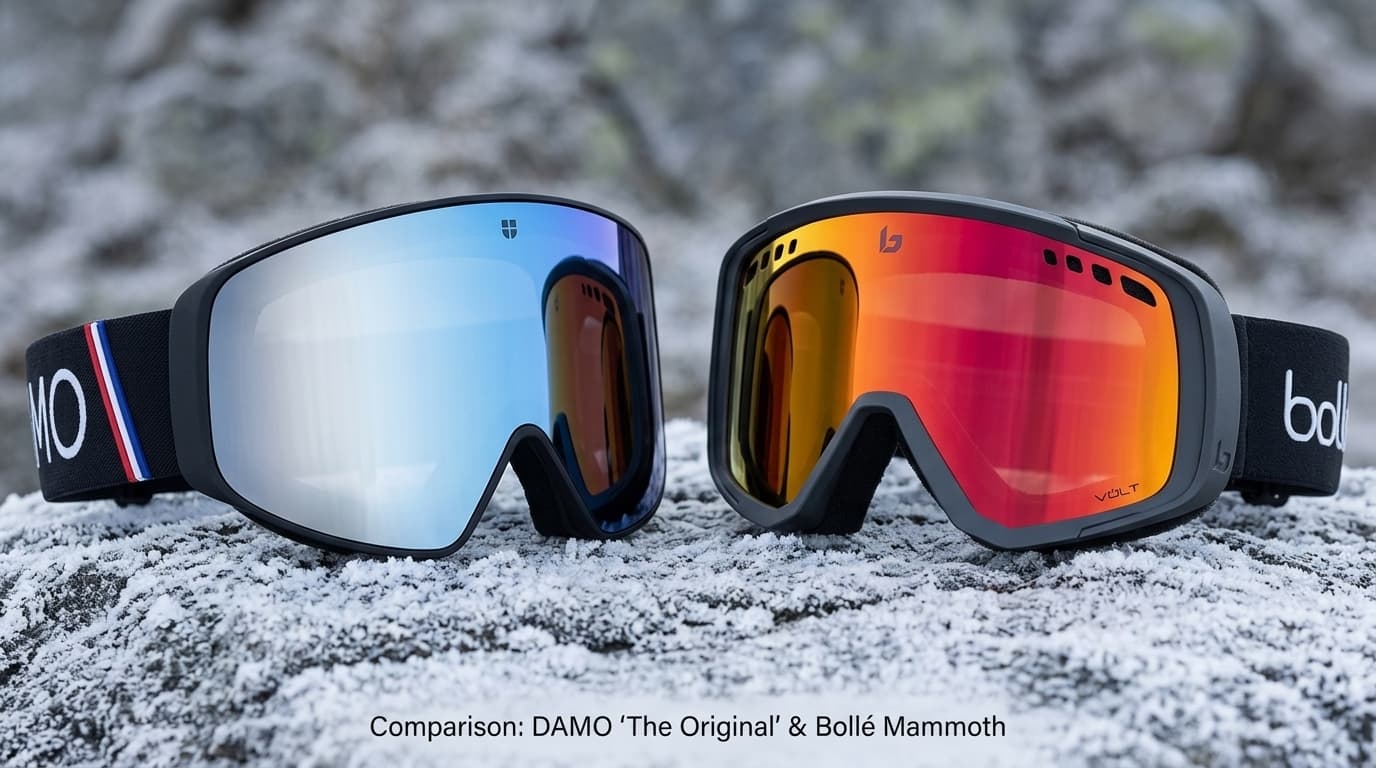
DAMO vs Bollé: Two Alpine Brands Under the Lens
Detailed specification comparison between DAMO and Bollé — no rankings, no "best" claims: Phantom photochromic, NXT lenses, pricing, warranty. Objective data as of August 28, 2026.
2026-08-28
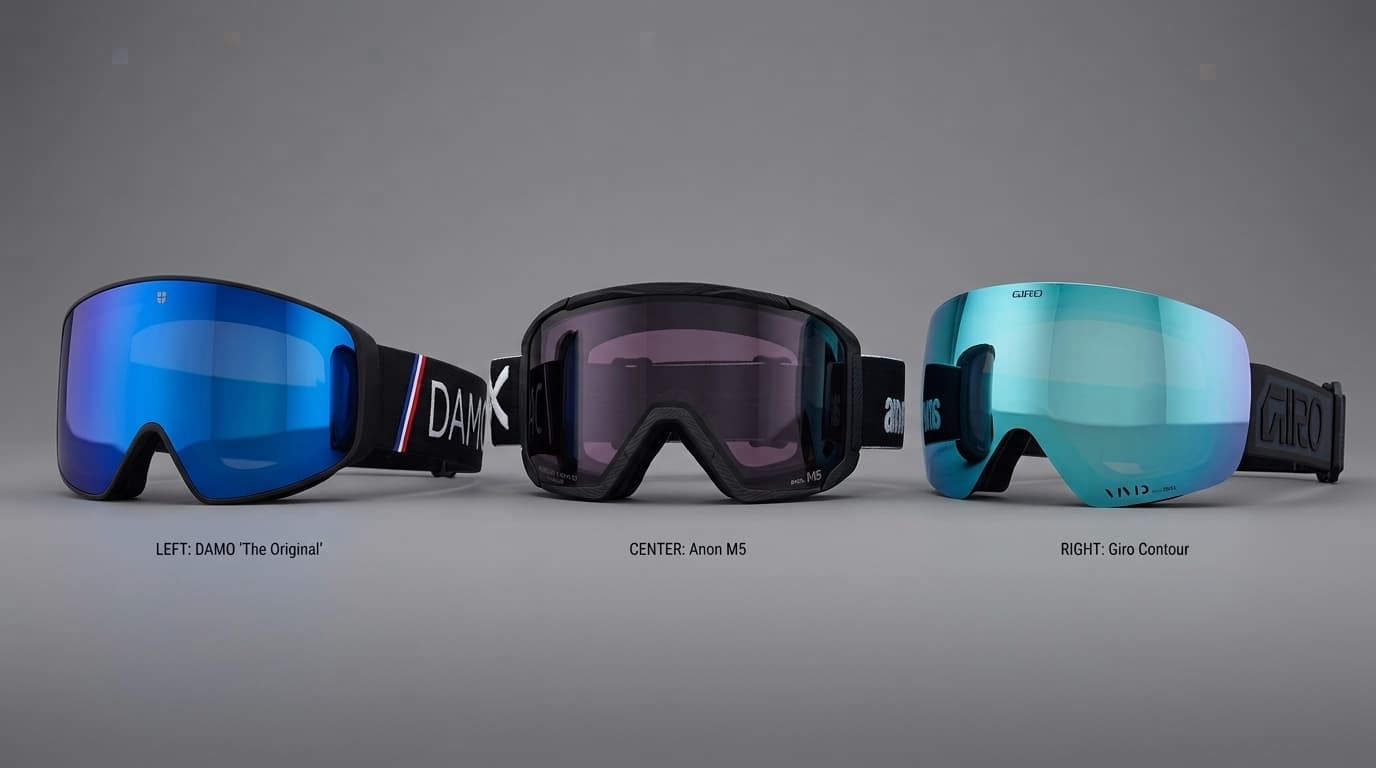
DAMO vs Anon & Giro: Lens Systems and Value Compared
Detailed specification comparison between DAMO, Anon and Giro ski goggles: Perceive and VIVID lenses, magnetic systems, pricing, warranties. Data as of August 28, 2026.